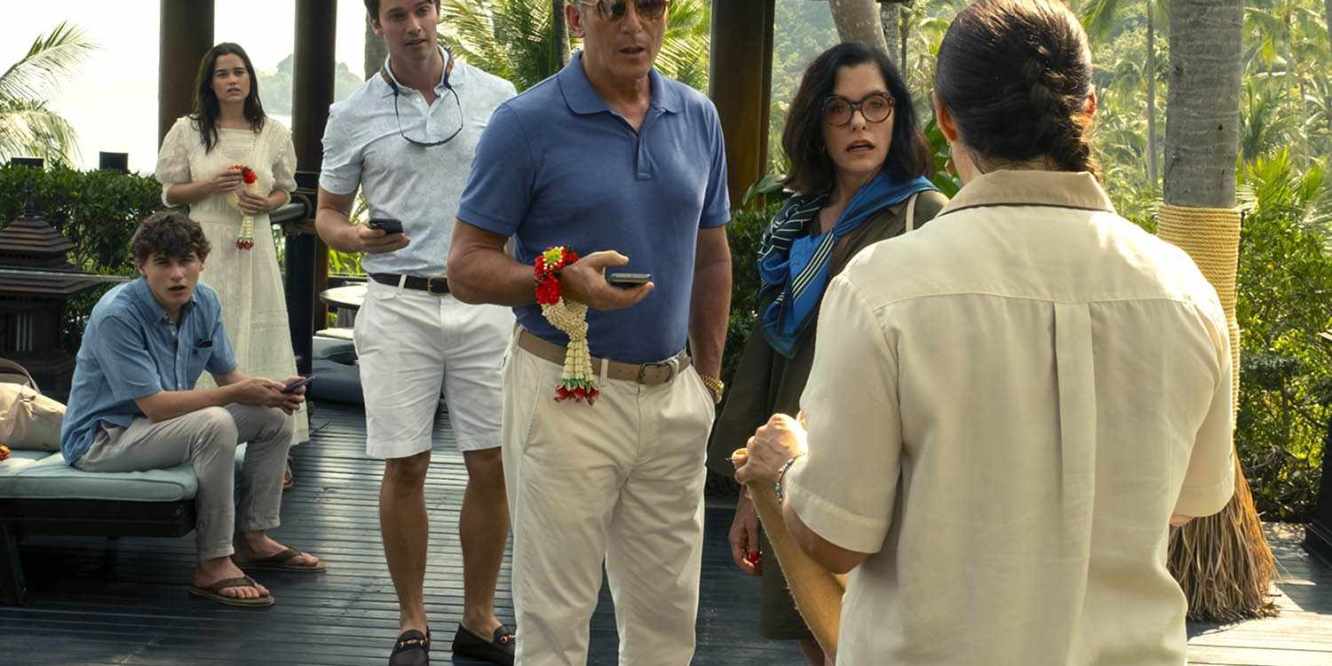
It took me a while to write this one. When I watched seasons one and two of The White Lotus, I knew right away what I thought and what I wanted to say. The blog posts practically wrote themselves. With the show’s third installment, I had to think about it a little more.
For season one, I felt like the overriding theme was white privilege. For season two, it was sexual politics. Season three also had a unifying theme, but it wasn’t necessarily clear in my mind when I finished watching. At a glance, it was hard to see what connected the characters. They all seemed to have such different problems. My first thought was that the theme was mortality, but after some more thinking, as well as seeing what other folks were saying online, I concluded that it “identity” made the most sense.
All of the main characters have their sense of identity tested this season, and so I’ve analyzed them strictly through this lens. Like my posts for seasons one and two, this won’t be a review of the season as a whole—it’s purely an exercise in analyzing how each of the characters represent the theme of identity. I should also note that I’ve only included significant characters here. If anyone’s missing, it’s because they didn’t have an arc of their own.
Obviously, there will be massive spoilers ahead and I’ll assume you already have the plot events fresh in your mind. Alright, let’s begin!
Rick

Rick’s identity is entirely defined by the life he feels like he missed out on. You get the sense that he doesn’t believe that he’s the person he should have been—that if his father hadn’t been murdered, then Rick would have grown into someone that’s well-adjusted, someone that’s good and kind. What’s interesting about this is that there are plenty of people who grow up without a parent and turn out just fine. Rick didn’t see his father getting murdered—he simply grew up without him, and was told years later by his mother on her deathbed that he was killed in Thailand.
This is undoubtedly a significant experience, but it isn’t a case of a horrific trauma leaving someone in a state of shock. And even so, there are people out there who do suffer such experiences, and much worse—people who survive wars and the like—who nonetheless don’t let it define them. Trauma is a lot more nuanced than that, and human beings have an extraordinary capacity to endure and adapt. Rick’s belief that he’s simply a product of trauma comes across as insincere. It becomes quite clear, I think, that this is actually a story he tells himself. Given his age, it’s much more likely that he’s looking backward at his life and ascribing his flaws to the loss of his father. We’re not given much detail about his life, but it’s hinted that he’s been involved in shady or illicit activity. He is clearly lacking in self-love, but I think this dissatisfaction with how he has turned out has caused him to blame the loss of his father for everything rather than taking responsibility for his decisions.
Ultimately, the loss of his father defines him because he lets it define him. He’s decided that he’s a victim, and that becomes his identity. Despite his belief that he’s the passive recipient of bad fortune, he’s actually making an active choice, every day, to play the victim. And so, feeling a profound sense of unhappiness with how his life has turned out, Rick decides that in the absence of anything positive to be achieved, the best usage of his time is to avenge his father. At the very least, it will give him a sense of satisfaction. In this way, his thinking reflects the Buddhist concept of karma, in which actions with good intentions result in good consequences and actions with bad intentions result in negative outcomes. Rick believes that if he can ensure that his father’s murderer receives that negative outcome, then he will have done one good thing with his life, not realizing that by the same logic, his own action will bring with it its own consequences.
None of this is to say that Rick doesn’t genuinely believe that his father was murdered or that he doesn’t genuinely want revenge. He obviously does. But there is an element of choice in indulging this desire for revenge and closing himself off from a happier life—that life being represented by Chelsea. Despite her many warnings and her unconditional love for him, he finds himself unable to tear himself away from this goal. My point is that while he might feel like he has no choice, that he is being pushed forward by the overwhelming force of emotions, the choice is actually happening on a subconscious level due to the way he’s identified himself in relation to the absence of his father. He’s telling himself that he is what happened to him, rather than identifying himself according to what he could be.
He’s also not entirely sure what kind of vengeance he wants. Obviously, he doesn’t rule out violence because he asks Frank to get him a gun. But one thing that Rick does seem pretty sure about is that he wants closure of some kind with his father’s murderer. He seemingly has it when he confronts Jim and pushes him over. Just seeing Jim lying helpless and frail on the ground, and having his life in his hands for a moment, proves to be enough to satisfy him. Rick feels powerful and seems content. But he doesn’t consider, not even for a moment, that even this somewhat mild confrontation will have consequences, and to the shock of absolutely no one except himself, he runs into Jim again when he returns to the hotel Jim’s wife owns. Idiot! Jim insults Rick’s mother and now he’s in a worse emotional state than he was before. Feeling like he tried the nonviolent route (Chelsea’s influence) and that it didn’t work, he then resolves to shoot Jim to get his closure. Of course, it’s revealed (in admittedly quite ridiculous fashion) that Jim was, in fact, Rick’s father. While I didn’t like the execution of this plot point, I did like the idea. Rick becoming the very person he believes ruined his life is a great way of illustrating that he’s the victim of his own decisions, a prisoner of the identity he’s crafted for himself. While the season was airing, I went to see a production of Oedipus starring Rami Malek and Indira Varma at The Old Vic—and I can’t help but see a stark parallel, most likely an intentional one, between the play’s titular protagonist and Rick. Obviously, in both cases the protagonist unknowingly commits patricide, but there’s also a sense of fatalism about it. Both Rick and Oedipus try and fail to control their own destiny, and the harder they try the more decisively they seem to pull themselves toward their respective preordained tragedies. Rick wants to liberate himself from feeling like a victim, but he has nonetheless built his identity around being one, and this informs his decisions, which then leads to him causing the very tragedy he was trying to avenge. By staying in the past, he destroyed his future, and remains the author of his own suffering.
Chelsea

Chelsea has built her identity around being a kind of healer—more specifically, Rick’s healer. It’s not really clear how the two of them met, or what her life was like before, but something about Rick’s pain ignites in her a sense of purpose. I imagined that before she met Rick, she maybe lived a hedonistic, partygoer lifestyle—perhaps similar to Chloe, or more accurately, pre-Buddhist Frank. Obviously we don’t know, but I’m basing my assumption on the scene where she tells Saxon that if they slept together, then it wouldn’t be fulfilling. Her whole demeanor is that of someone who’s lived a debauched, pleasure-seeking lifestyle but got tired of it. She speaks like a woman with experience, completely untempted by the idea of a one-night stand because she knows how it will make her feel.
I also got the impression that she didn’t just go around trying to save people. From the way she spoke, I got the sense that maybe she met Rick while feeling disenfranchised with a life of partying. And the discovery of a genuine connection in the midst of a cycle of no-strings-attached sexual encounters gave her this newfound sense of purpose. There was something about Rick’s pain, I feel, that awakened her own sense of self. Perhaps before that, she felt directionless and adrift, another British backpacker escaping the housing crisis of the UK to bumble around Southeast Asia and live day to day, moment to moment. This was the picture that came to me, but sadly we got very little background information compared to other characters.
What’s clear is that Chelsea is absolutely convinced that she and Rick are two halves of a whole—that she is meant to take the full weight of his pain upon her own back and help him achieve inner peace. And so despite his continued ill-tempered selfishness, Chelsea showers him with unconditional love. If anything, Rick’s cold, self-absorbed behavior only serves to reaffirm her devotion. Knowing that he lost his mother at a young age, she feels strongly that what he needs is that unconditional love—that complete and total acceptance of all his faults. Although much younger than him, Chelsea takes on a quite overtly maternal role. Rick, a wealthy man in his mid-fifties, plays the wayward, sulky, and volatile child. Chelsea, on the other hand, acts the calm, patient, understanding, and wise parent. Even the one sex scene they have reflects this dynamic, with Chelsea on top and in control, and Rick helplessly and hungrily suckling at her large breasts. It seems more an act of consolation than passion, like he’s surrendering to her care. Obviously, it’s hard to tell if this kind of framing is intentional or if it reflects Mike White’s subconscious conception of their dynamic, but either way, it’s not the first nor indeed the last time this season that familial roles and sexual ones have become blurred.
When I look back on Chelsea and Rick’s storyline, I feel like it’s meant to be understood in spiritual terms. They’re not realistic characters, and the overwhelming majority of viewers won’t be able to relate to them the way they do the rest of the guests. Usually, The White Lotus features characters that viewers will be able to recognize from their own lives—just in more exaggerated or comedic ways. Even Lochlan, little weirdo that he is, has many moments of relatability. Rick and Chelsea, however, represent a divergent strand of the show’s storytelling. They’re not meant to represent real-life themes or archetypes, the way other characters might embody wealth, social class, masculinity, idealism, cynicism, sexual politics, and so on. They don’t even provide a commentary on age-gap relationships, which is probably why there is so little discourse along the lines of power dynamics. Instead of commenting “Ugh, why doesn’t she leave his sorry ass”, “Queen he doesn’t deserve u”, or “Omg he’s such a red flag”, viewers have been focused on how Rick and Chelsea represent the concepts of fate, determinism, and reincarnation. That’s because most viewers see them as vessels for allegory rather than realistic individuals. A recurring favorite, which I agree with, is that they’re a personification of yin and yang. Although not inherently a Buddhist symbol (derived instead from ancient Chinese philosophy), yin-yang has been incorporated into some Buddhist traditions for the way it echoes related ideas about interdependence and the duality of opposing forces.
I think this is something that Mike White has done quite intentionally and quite overtly in his writing of Rick and Chelsea. Buddhist ideas of interconnectedness and duality are prevalent throughout the season, as we see in Timothy’s interaction with the monk and Frank’s monologue about wanting to become an Asian girl. These dichotomies exist within each of the characters, whether it’s Piper and Gaitok caught between the pull of spiritualism and materialism, Lochlan between wanting to please and wanting to assert himself, Belinda between doing the right thing or the self-serving thing, or Laurie between bottling up her insecurity or confronting it. Each character is defined by these conflicting forces, and in some cases—such as Piper, Gaitok, or Belinda—the darker, more cynical half comes out on top. What makes Rick and Chelsea different is that they are each, unto themselves, competing halves of a whole; a single soul divided into opposing yet complementary forces. Rick is yin, the dark, cold, and negative aspect of the spirit, while Chelsea is yang, the spirit’s light, warm, and positive side. Both sides are necessary, and we see pretty much every character exhibit this duality. But for stylistic reasons, Rick and Chelsea are written as symbolizing these contrary parts.
Chelsea is the hope to Rick’s futility, the peace to his torment, and the comfort to his pain. I’m not sure if her being a woman or a young person has any particular significance, but if I were to guess, I’d say that Mike White is reversing traditional gender and age roles to make an ironic statement. Chelsea, though much younger, is the protector, even-tempered and wise, whereas Rick (despite being much older) is the child who, in the absence of parental support, never grew up, and is constantly volatile and helpless. She’s also yang, which is associated with masculinity and action, while he embodies yin, which is supposed to represent femininity and passivity. In this way, the allegory Mike White is going for doesn’t quite hold up, as Rick is obviously the one whose actions and decisions drive their shared plotline, while Chelsea is the victim of those actions and decisions. However, you could argue that Rick displays many elements of passivity, in that he struggles to break out of his victim mindset and lets things happen to him, whereas Chelsea believes in taking charge of your life. I think the gender roles in their relationship might have less to do with yin-yang and serve more as an interesting reversal of traditional power dynamics for western audiences. When we see older men with much younger women, the assumption is usually that the man is exploiting her with his economic power, and the woman is naïve or vulnerable in some way. We even see references to this with Greg and the guests at his parties. But with Rick and Chelsea, the expected dynamic is turned on its head. It’s the man that’s vulnerable and hysterical, and the woman that’s strong and resourceful. So perhaps it’s more about avoiding the stereotype of the wealthy older man that dominates the impressionable young woman, but I can see how Chelsea also embodies aspects of yang as well. Ultimately this is a crude allegory, and the concept of yin and yang is too complex for either Rick or Chelsea to fit with any exactitude, but I appreciated what it was going for nonetheless.
What’s certain is that their fates are intertwined, as yin and yang are not separate entities. Despite her correct prediction that Rick’s obsession with trying to right the wrong of his father’s (apparent) death will doom them both, she never waivers in her commitment to him. In the end, she gets a bullet through the heart because of Rick’s decisions. In spiritual terms, I guess you could see it as the rational aspect of the spirit being unable to overcome the destructive one, which damns the spirit to death. Chelsea’s violent fate is foreshadowed quite heavily by Aimee Lou Wood’s title card, which depicts a decapitated deer being feasted on by a leopard as several wild dogs come to scavenge the carcass. I think this is my favorite of all the title cards, because it’s the hardest for me to interpret. You could see Chelsea as the deer carcass and Rick as the leopard, since he’s directly responsible for her death. Just as a leopard knows only how to be a leopard, it’s his destructive nature that kills her. If this is the case, I guess you could see the three feral dogs as Gaitok and the two security guards. Alternatively, you could see Chelsea as one of the dogs, following her pack with blind loyalty down a dangerous path (toward a bloodthirsty leopard). I like both but if I had to pick, I’d probably go with the first one. Neither interpretation fits what happens perfectly though, which makes it interesting.
Timothy

Timothy’s identity is one very much shaped by the men in his family, and this immense pressure he’s always felt to live up to the Ratliff name. He’s proud of that name, but you can see that it comes with a lot of baggage. The weight of expectation that comes with it is so great that he doesn’t feel like he can be anything else; in his mind, failure to live up to it is tantamount to death. The respect and admiration of his family serves to increase the pressure he puts on himself—so much so that he would rather die than see their image of him shattered. And what’s more, not only can he not bear to witness their disappointment, he can’t even stomach the thought of them being disappointed after he’s gone—and so, knowing that prison can’t be avoided at this point, he decides upon the completely normal and level-headed response of murdering his entire family.
While the whole “murder-suicide” plot felt a little silly to me, I found it interesting from a character perspective. I got the sense that Timothy had always felt a strong sense of imposter syndrome. Despite his obvious success, he seems to have internalized the mythology of the Ratliff dynasty to such an extent that he feels like he’s continuously plate-spinning; having to expend constant effort maintaining the “great man” image he thinks everyone expects of him. It’s almost as though he feels like a single lapse in concentration on his part would result in the whole image collapsing like a house of cards. And he simply can’t bear the thought of being seen as anything less than extraordinary, to see the confirmation of his insecurities in the gaze of those closest to him.
Although we get scant details into his illicit activity, I wondered if it was driven by this fear he has of not measuring up to his father and the other Ratliff men that came before him. It’s left unclear whether the money laundering scheme was something that he stumbled into as a one-off opportunity brought to him by his partner or something Timothy himself initiated as part of a calculated, ongoing habit. I like to think it’s the latter, because if his success is built on illegal activity, then it makes his insecurity more believable and his arc more powerful. It fits the theme of this once-proud dynasty that’s rotting away from the inside quite well. For instance, we see many times Victoria’s steadfast belief in the superiority and moral purity of their family, this idea that they’re good people and that means something. That they have an innate goodness that sets them apart from the depravity of the modern world. Victoria regards other people with suspicion and judges them harshly for their flaws. She likes to think that her family remains untouched by the dark side of humanity, which is why she’s so afraid of Piper spending an extended period of time outside their community. In her view, if her kids stick to their roots and follow Timothy’s example, then they’ll turn out alright. Timothy knows this, and of course, he’s keenly aware of the irony.
What we see in season three is Timothy crack under the weight of pressure that comes from a lifetime of performance. I like to think that he turned to illegal activity out of a desperation to prevent the mask from slipping, so to speak, but in so doing made it inevitable that it would one day slip. The dirty money meant that he could maintain his successful image and his family’s privileged lifestyle, but ensured a more catastrophic collapse in the future. As part of the image he’s trying to live up to (the image of forefathers), Timothy assumes the role of the sole provider for his family—a role that prevents him from feeling like a failure, but which increases the pressure he puts on himself. It’s during the trip to Thailand that Timothy realizes that in doing this, he’s created a family that’s both highly materialistic and highly dependent on him—so much so that he convinces himself they’d be better off dead without the lifestyle his dirty money facilitates for them.
It’s quite a tragic story when you think about it. Timothy’s desire to make his father proud and provide a good life for his own family are both noble aims. But in pursuing them the way he does, he becomes an absent father which causes all three of his children serious emotional problems that can’t be easily reversed. It’s hard to watch the events of season three and not think that Saxon, Piper, and Lochlan might have been better off had Timothy settled for a more modest life wherein he was an emotionally available parent. And, of course, there’s the not insignificant fact that his decisions led to an outcome where he very nearly poisons all of them—to say nothing of the material loss and psychological trauma that will presumably come following his arrest.
Timothy’s bad decisions are represented quite cleverly by Jason Isaacs’ title card in the opening credits, which depicts a man perched in a tree with swords dangling from its branches. Obviously he climbed it himself, but now he’s trapped in quite a dangerous position—a rather on-the-nose, but no less effective, metaphor for Timothy suffering from the consequences of his own decisions. He’s taken a path that’s facilitated a lavish lifestyle, but that path is a precarious one. Trees of hanging blades are a popular image in Buddhist depictions of hell, and you can actually go to hell theme parks in Thailand where these trees are recreated to scale, along with other representations of torture. The tree of swords illustrates well how Timothy feels trapped and now he’s in a very dangerous position. But right at the last possible moment, he lets go of his pride, takes responsibility for his decisions, and realizes that no amount of material discomfort is worse than death. He’s convinced himself all these years that it’s the material things he’s provided for his family that makes their lives worth living, but once he’s on the cusp of actually losing them, he concludes that what’s really important is life itself—and its myriad of possibilities. I guess it’s a little cliched in that way, but the series as a whole is about the psychological lives of rich people, and I think the way Timothy finally dispenses of a materialistic identity ties in nicely with the Buddhist philosophy of overcoming suffering by letting go of attachments.
Victoria

Victoria’s identity is tied very strongly to social class. Unfortunately, we don’t get much insight into her background or her inner life. Victoria never feels like a POV character the way the other members of her family do—she seems to exist largely in service of Timothy and Piper’s character arcs, and as a source of comic relief of course. She’s the only member of the Ratliff family that doesn’t have an arc, and unlike the others, she never once questions her identity during the season. Victoria is someone who’s very much a product of her environment, that environment being the old aristocracy of white Anglo-Saxon Protestants in North Carolina. She’s someone that is simply not curious about the outside world, which I think we can take to mean that she was born into one of these old families, that she was probably just a wealthy socialite before marrying Timothy, whose family name made him an excellent candidate in her eyes.
Based on how she talks, both to her children and to the young women she meets at Greg’s parties, it’s clear that she has very strong ideas about which people are of “good stock”. And this is something that goes beyond just money—for her, it’s about belonging to a very particular class. For instance, the older men at Greg’s parties are undoubtedly well-off, but Victoria nonetheless looks down on them. Good stock, in her eyes, means prestige. It means old money, not new money. It means names that carry weight, not tech bros, yuppies, startup entrepreneurs, and other stereotypes of the vulgar nouveau riche. It means good connections and family members who are powerful and important. It means people like Timothy, who on paper exemplifies everything she means by good stock. Not the likes of Rick or Greg, but people who belong to her community, who abide by a sense of etiquette, chivalry, and good manners that assures them they are good people.
That’s what makes Timothy’s secret so interesting—and why it’s so frustrating that we never get Victoria’s reaction to it—because he has obviously fallen short of the high standards that she expects of him. In committing fraud, he’s no different to the Ricks and Gregs of the world; he’s lost that moral purity. What makes this so significant is not just that Victoria will be poor, it’s the fact she’ll be robbed of the prestige she places such high importance on. Without this prestige, she’ll no longer be a part of the strata of society she’s built her identity around. She’ll be forced, for the first time in her life, to look inward for meaning. Untethered from that world, she’d become a lot like Rick in many ways—and it’s interesting to think about how she’d spiral, search for meaning, and ultimately seek to define herself.
Saxon

Saxon represents the continuation of the cycle perpetuated by Timothy and the men of the Ratliff family. Saxon is proud to be a Ratliff and believes that the name carries with it a sense of importance. He’s probably the character who interested me the most this season, and—along with Laurie—arguably has the most complete, compelling arc. It’s clear from the outset that Saxon has built his identity in the image of his father. There is something touching about the way he wants to make his father proud; Saxon works at his father’s company and by all accounts seems to be a hard worker. But the problem with Saxon is that everything he does, he does to appeal to external or imagined expectations. There’s no genuine, intrinsic passion—the kind that comes from a natural, self-possessed sense of identity—that drives his behavior.
That’s why Chelsea calls him soulless. He emulates his father because that’s what he believes is expected of him. He bulks up and tries to hook up with as many women as possible because that’s what popular culture tells him a man should do. His entire personality is one big exercise in mimicry, a tissue-thin façade aimed at imitating these very superficial stereotypes—the generic alpha male and the myth (not the reality) of his father. And it’s all about chasing the validation of others so that he can feel like a real person, when in actuality he’s only acting like one. I think we can best understand Saxon’s identity as one of performance. And while this is due in part to the influence of popular media, it more fundamentally reflects the fact that his father isn’t the man everyone thinks he is. Timothy Ratliff is also one big performance. And so Saxon has fallen into a cycle in which we have a performance unknowingly imitating another performance, resulting inevitably in a very shallow personality. It seems to me that Timothy’s well-intentioned focus on being a material provider has come at the expense of being present in his children’s lives. In cultivating the myth he feels he needs to live up to, he’s created a distance between himself and Saxon. Saxon admires his father, because he facilitates their privileged lifestyle and runs a successful company, but he doesn’t really know him on a deeper level. And the absence of a male role model that’s active and involved in his life explains a lot about Saxon’s behavior. It explains his complete lack of boundaries, his lack of empathy, his treatment of women, and his susceptibility to toxic masculinity.
Personally, I can’t think of an insult much worse than being called “soulless”. After all, what does “soulless” mean? It’s a word we use to describe something that’s completely lacking in depth or originality, something that has no flavor. Something that’s forgettable and anodyne. It makes me sad to think of someone being called that—it seems worse than being insulted for your intelligence, skills, or looks. So initially I thought Chelsea was being way too harsh, but she later follows it up with some genuine sympathy and it’s implied that she sets him on the path to becoming a better person. Obviously, we don’t see her message truly set in during the course of the show, as it would be a little unrealistic for his whole personality to swivel on a dime, but we can at least feel confident that the seeds of growth have been planted. After the Full Moon Party, Saxon’s ego has taken a big hit, and this makes him more open to Chelsea’s ideas. I mean just think about it: you consider yourself an alpha male and make a big show of trying to look impressive, only to get rejected by Chelsea, find yourself unable to handle the drugs you were peer-pressured into taking, and then the only action you get is your own brother. And doubly humiliating, the little brother you previously considered helpless and inept is able to handle the drugs like a pro, and ends up having quite vigorous sex with the one girl in Thailand that wasn’t repulsed by you, while you—unable to perform—get only a pitiful tug job as would the sulking hound of archetype be passed the unwanted scraps from a rather sumptuous feast. It’s basically the worst possible outcome for Saxon when he took it upon himself to impress Lochlan by sleeping with a beautiful woman on holiday.
But oddly enough, this experience sets him up for positive change. I’ve always felt that there’s some truth to the idea that sometimes you have to hit rock bottom to bounce back up. I think when it comes to people like Saxon who are very proud, arrogant, and overly sure of themselves, it often takes a complete humiliation to get them to reflect on their behavior. The “alpha male” image he tries to maintain has been suddenly and painfully stripped away from him, and it’s when your vulnerabilities are visible like that that you stop pretending. He’s essentially forced to be honest, because Chelsea has seen past the performance at this point. And it’s in this vulnerable, unmasked state that Saxon is finally amenable to new ideas. He still wants to fuck her—remember that. His personality hasn’t done a 180. He’s in a confused, questioning, vulnerable state at this point. But you can see that, despite still trying to get in her pants, Saxon is becoming a more self-aware person and that he’s seriously starting to reflect on his identity. He seems to be asking “Who am I?” and “Who can I be?”. He even recognizes that he’s tied his identity to his father, and looks visibly distressed at the realization that he hasn’t invested in himself, lamenting his lack of hobbies and interests.
This self-reflection is encapsulated superbly by what I think is the best moment in the whole season, which is the expression on Saxon’s face when he watches Rick and Chelsea embracing each other on the beach. This one shot might be the only moment this season that genuinely moved me. Saxon realizes in this moment that all his relations with women have been purely transactional—that he’s leveraged his status, looks, and money for purely superficial encounters based on instant gratification. When Saxon looks at Rick and Chelsea on the beach, you can see that it’s not Chelsea specifically that he wants—it’s to be loved. This one shot turned someone that began the season as an obnoxious, predatory, somewhat laughable stereotype into the show’s most sympathetic and human character. And you have to give Patrick Schwarzenegger all the credit for that. In that scene, Saxon realizes that he’s never felt truly wanted by someone. It’s always been a transactional exchange. And who doesn’t want to feel wanted? He wants someone to light up when they see him, the way Chelsea flings herself across the beach in a great outpouring of emotion. He wants to know what it feels like to mean that much to someone—and the only way he can experience that is if he treats women differently. So, in a season of quite cynical endings, Saxon leaves us with hope that he might forge a new identity for himself and become a kinder, more empathetic person.
Piper

Whereas Saxon builds his identity around continuing the family legacy, Piper identifies herself in contrast to it. And while it’s easy to mock her for idealizing a foreign religion and so loudly adopting it as her identity, this actually makes complete sense for someone like her. The pull of faraway ideas is especially strong for young people, and in Piper’s case she’s someone who’s been raised in a community with a very inward-looking mentality. The nature of privilege is that it’s a very small, exclusive club. She’s been raised to believe in the importance of her family name, that validation should be sought from either her family or families like hers, that meaning is derived from the approval and admiration of those within that small circle.
It’s only natural that Piper would feel curious about the world beyond that circle, and that upon leaving home and being exposed to new ideas at college, she would find those ideas very attractive. It’s natural too, I think, that having known nothing but privilege, luxury, and comfort, one would find that lifestyle empty and unfulfilling. It’s not that she doesn’t like her family or anything like that; she’s just trying to assert her independence. I think the fact that her older brother, Saxon, is so readily following in their father’s footsteps intensifies her desire to be different. He’s already succeeding in living up to the legacy of the Ratliff name, and she likely feels insecure that in trying to do the same, she won’t measure up as well. I really believe that if she were the eldest sibling, things would be different. But the fact that Saxon has essentially already achieved their parents’ dream for their children torpedoes any motivation Piper might have had to do the same. If she follows the path Saxon has just taken, then (in her eyes) she won’t be special.
And like any middle child living in the shadow of a firstborn favorite, Piper wants to be special. Rather than competing directly with Saxon for the Ratliff legacy, she seeks to outcompete him by succeeding at something else entirely. It makes complete sense that she’d become fascinated by Buddhism, a belief system which seems like the antithesis of the shallow, materialistic world of her family. And by adopting this philosophy, she’s subtly undermining the value of the path Saxon has taken—rather than beating him at being a Ratliff, she’s subconsciously suggesting that being a Ratliff isn’t all that great.
I also think her relationship with her mother has as much to do with it as her relationship with her older sibling. While Victoria maintains an air of superiority, she’s clearly not happy. She’s comfortable, yes, and she’s so accustomed to a life of privilege that she doesn’t know how to function without its comforts, but she’s not fulfilled in any way. Nothing inflames her passion or curiosity. She’s not striving for anything. And so, unsurprisingly, this doesn’t make her an inspiring figure for a young person to emulate. I think Piper correctly sees her mother as someone that’s bored, unfulfilled, and lacking in purpose, and who avoids confronting the emptiness of her life via habitual self-medication. And Victoria, it feels, needs her daughter to take the same path she did so as to feel better about her choices. The question this season asks is whether or not Piper has the strength of character to forgo material comfort in pursuit of a more meaningful life than the one her mother has lived.
Piper plans to stay at a Buddhist monastery in Thailand for a year and learn from an old monk whose writing she greatly admires. You can’t blame her for finding this appealing; to do so would be to prove that she’s unlike her family in the strongest way possible. Thailand is almost the exact opposite side of the world as North Carolina; she couldn’t be farther removed—geographically, culturally, and spiritually—from the community in which she was raised than by staying at this monastery, living frugally, and studying Buddhist philosophy. It would be a hugely character-building experience and a supreme test of her inner resources. However, while I don’t doubt that Piper is genuinely interested in Buddhism, she wouldn’t be going for the right reasons. She obviously admires this old monk fellow a lot, but it seems like it’s more important to her to shock her family and define herself in contrast to them. Before the trip, she would have genuinely believed that her motivation was purely spiritual. It’s only when she arrives in Thailand and stays in the monastery for a night that she realizes that her family are actually tied inextricably to her decision. I found this very human and relatable. I remember when I studied abroad in the USA intent on redefining myself, only to realize once I got there how inseparable my family and my community were from my identity.
The key moment in Piper’s storyline is when Lochlan expresses a desire to stay at the monastery too. All of a sudden, Buddhism is not something that’s special to her anymore. And Buddhism is something that Piper has built her identity around, so this is quite crushing for her. I’m sure anyone with siblings can relate—you want so desperately to be unique, to have something that’s yours and yours alone, that it threatens your sense of self when you realize it can be attained both quickly and with ease. That if her little brother decides on a whim to be a Buddhist too, then he’s as much a Buddhist as she is in the eyes of their family—regardless of how long she’s been studying it. And so, it’s in this mindset that the downsides of staying at the monastery—chiefly, the absence of material comfort—become more striking. Her heightened sense of these downsides is absolutely informed by Lochlan’s casual and spontaneous declaration of interest in joining her. I think that if Lochlan hadn’t expressed a wish to join her, and had maybe said something like “Wow, that’s really impressive that you’re prepared to live like that for a year, I couldn’t do that”, then Piper likely would have suppressed her discomfort with the monks’ frugal lifestyle. She would have had her doubts that it was really for her, but she’d have more motivation to face them. And who knows how she’d have adapted if she went? I’ve never done something like that, but I get the sense that it’s part of the experience that it’s difficult. Maybe she would have developed the strength to adapt, and then by the end she would have gained something valuable.
Of course, that’s not what happens though. The idea is immediately tainted once Lochlan expresses his desire to join in, and Piper abandons the whole thing quite quickly, despite having planned it for a long time. She lashes out at her little brother because of the way he’s shined a light on her true motivation for wanting to go—the very human desire to be seen as special and impressive by those she loves. It’s embarrassing for her to have it brought into the open that her motivations are very normal. That they aren’t profound motivations, the kind her materialistic family won’t understand, but common ones. That it all comes from a place of vulnerability, a need to prove to herself and to others that she’s special—which can only come from a deeper insecurity that she’s not enough.
Lochlan
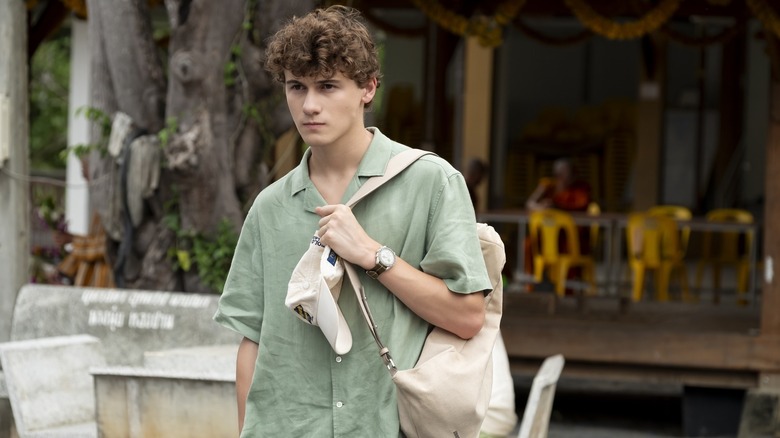
Of the three Ratliff children, Lochlan’s identity is the most fluid, the most pliable. Curious and lacking direction, Lochlan is desperate for a sense of belonging. All three of the Ratliff children are shaped by the weight of their family name. Although this could in theory happen to any family, it occurred to me that children of ordinary, middle-class families likely feel a lot more freedom to be who they want to be, despite having less material opportunities. Those like the Ratliffs, however, no doubt feel constrained by names already associated with political or entrepreneurial legacies in the public consciousness.
As mentioned in the preceding sections, we saw Saxon react to the Ratliff legacy by building his identity around it and Piper react to it by building her identity in contrast to it. In both cases, though, the weight of the family name resulted in each of them developing a very strong sense of identity. They’re both certain about who they are. With the youngest Ratliff sibling, however, we see the opposite. Seeing his older siblings possessing such a firm sense of identity only serves to make him feel more lost and more abnormal. From Lochlan’s perspective, they have complete clarity about who they are and what they believe, and seem to navigate the world with certainty and purpose. This is the most relatable aspect of Lochlan’s personality. Who among us hasn’t looked at another person and envied their apparent sense of self? Who among us hasn’t felt lacking in a distinct sense of identity?
When the three siblings arrive in Thailand, Saxon and Piper are very sure of themselves, while Lochlan looks to them for direction, not really knowing who he is or what he wants. Everyone can see his uncertainty and everyone seems to take it upon themselves to help him become a man—according, of course, to their idea of what a man should be. Saxon encourages Lochlan to bulk up, drink protein shakes, and sleep with women. Piper encourages him to be thoughtful, conscientious, educated, and progressive. And his parents encourage him to take a class to improve his posture, which I think is quite an interesting detail, because it’s immediately infantilizing. It suggests that he’s not a fully formed person, and no doubt heightens his insecurity that he’s helpless or incapable of navigating the real world. After all, Lochlan isn’t a child. But he is treated like someone much younger than he is, and he felt to me like the classic case of someone leaving their adolescence with a strong sense that they are missing something important.
The Full Moon Party serves as the turning point in Lochlan’s arc. Before the party, he spends the season trying to please Saxon and Piper while repressing his desires. The party is a turning point because it marks the end of his passivity, and feeling uninhibited by the drugs, alcohol, and free-spirited atmosphere, he indulges in those repressed desires for the first time.
At first, I wasn’t sure what to make of Lochlan’s attraction to his older brother. I was intrigued by this plotline and admired Mike White’s decision to tackle a taboo subject, but I wondered what it was all in service of. I was worried that this was being done purely to shock the audience, which would be disappointing. Incest is something that’s quite unusual in real life—it’s something that typically takes the form of sexual abuse enforced by an unequal power dynamic, or it’s something that occurs in very isolated rural communities. But a more or less grown man having a secret longing for his older brother is extremely unusual, so I was wondering how Mike White was going to make it compelling and believable.
My initial interpretation, early on in the season, was that this plotline was all about Lochlan’s sexuality. I thought that Lochlan was a closeted homosexual, and that somehow his repressed sexuality had manifested in an attraction toward his own brother—an older male who he admires and is close to. It reminded me of a study I’d seen a while ago that determined that boys with older brothers have a much higher probability of being gay (see: Fraternal Birth Order Effect). I thought that maybe this was one of those stories that portray Freudian concepts in a literal way for artistic purposes—the idea that sexual partners take on roles previously carried out by familial connections. When Lochlan stares at Saxon’s bare arse at the beginning of episode two, I imagined that he wasn’t so much seeing his brother as he was seeing all men; that through the family’s insulated closeness and lack of boundaries, Saxon had come to represent the masculine ideal to him. Saxon is older, he’s in good physical shape, he’s successful, he’s confident, and—perhaps most importantly to Lochlan—he’s someone that seems to live life on his own terms, someone who knows exactly who he is. So for a confused, repressed, and impressionable young man like Lochlan, Saxon is the exact sort of person he’s likely to become infatuated with. This is where my mind was at before the Full Moon Party.

After this event however, it became clear that the incest plotline wasn’t about Lochlan’s sexual orientation. His sexuality was left undefined and irrelevant, and it seemed to me that he wasn’t seeing a male archetype in his brother—he was literally just seeing his brother. Obviously, only Mike White knows why Lochlan feels the way he does, but I got the sense that Lochlan’s attraction to Saxon was all about their dynamic as siblings. The only real insights we get from Lochlan are his remark to Saxon at the Full Moon Party that he wants to “take him down” and that scene in the last episode where he says that he’s a “pleaser”. The first one seems more genuine—this is Lochlan feeling uninhibited and saying what’s on his mind for a change. It suggests that his attraction to his brother is more about dominating him sexually to reverse their power dynamic. After all, Saxon does wield sexual power over him, in that he boasts of his own sexual exploits, pressures Lochlan to have sex, and takes it upon himself to be Lochlan’s teacher. Even though Saxon’s advice might not necessarily be unwelcome, the simple fact of being placed in the role of the student instils in Lochlan an instinctive desire to rebel. And given that Saxon seems obsessed with sex, that conquering women seems so much a part of his identity, the ultimate way Lochlan can prove himself is by fucking him; to dominate the dominator, to put him in the submissive role. Lochlan would essentially be making Saxon the woman—all the women Saxon has “conquered”, so to say. And that role reversal bringing things full circle, leading to a deeper self-knowledge, echoes in many ways Frank’s monologue where he confesses to exploiting an unequal power dynamic to conquer women, before reversing the dynamic and wanting to take on the woman’s role. In Frank’s case, his desire to inhabit a new identity is connected to Buddhist beliefs about the fundamental interconnectedness of human existence; only by stepping outside of the narrow confines of how he’s defined himself can he achieve true self-knowledge.
As for Lochlan’s claim that he’s a “pleaser”, I think this is not untrue, but its authenticity is questionable given that he wants something in this scene. He’s trying to make amends, and could be trying to rationalize something that he himself doesn’t fully understand yet. But the notion that he’s a people-pleaser does make a lot of sense. As mentioned earlier in this section, he’s the younger sibling of two very strong, competitive personalities. With Saxon and Piper each trying to mold Lochlan in their image to validate their respective choices, Lochlan naturally becomes a people-pleaser, succumbing to their assertiveness and trying to keep the peace. So there could be some truth to Lochlan’s rationale—Saxon does always talk about wanting to “get off”, and has so far been unsuccessful in Thailand, so it could be that Lochlan masturbated him because he wanted to “help”. But it doesn’t change the fact that Lochlan did it because he simply wanted to do it.
My best explanation for this plotline is that it’s not trying to portray incest in a realistic sense, but to use it as a kind of Faulknerian literary device. That it’s not so much what literally happens that’s important, but rather that the incest serves a thematic purpose—perhaps to explore the strangeness of these extremely insular, high society families that seem out of place in the modern world. There’s a suggestion that the self-importance of these inward-looking, old money families creates a distance between them and the rest of the world, which in turn leads to an unnatural closeness and a lack of boundaries. For instance, Saxon watches porn in front of Lochlan and openly speculates on Piper’s sex life, calling her “hot”. This behavior helps to blur the lines between family and sex for the impressionable Lochlan. And perhaps most significantly, we have the scene where Victoria tells the story of how her older brother would pin her down and spit in her mouth when they were growing up—an overtly sexual image. All of these things together—in conjunction with Timothy and Victoria’s absent, laissez-faire parenting style—create a home environment with a complete lack of personal boundaries, of which Lochlan’s sexuality is a symptom. So I think of the incest as an example of an outdated institution (the Ratliffs) that refuses to adapt to the times, which in turn leads to its moral decay—kind of like the once-proud plantation families in Faulkner novels, or real-life examples of antiquated, eccentric, slowly crumbling dynasties from history, like the Habsburgs or the Ptolemies.
As the series comes to its conclusion, Lochlan is left more lost and confused than ever. Both his attempts to please his siblings have been angrily rejected. He doesn’t understand why Saxon’s upset with him when he gives him an orgasm or why Piper’s upset with him when he commits to joining her spiritual journey. In his mind, he’s doing what they want him to; he’s embracing what’s important to them. Remember, they’re constantly preaching to Lochlan about sex and spiritualism respectively. And so it’s in this state of mind—the realization that he doesn’t truly understand how to connect with them, that trying to emulate them hasn’t worked—that he has his near-death experience. This is important. This realization informs the dream he has and how he interprets it when he wakes up.
Lochlan has a vision of himself drowning while looking up at the blurry silhouettes of four Buddhist monks—one for each of his family members. When taken with the events prior to the vision, it seems to me that this represents his inability to connect with them. The monks stare down indifferently at his drowning person as he strives to reach them. He can’t see them clearly beneath the water, mirroring the way he misinterprets them in real life, unable to truly see what drives their behavior. By the time he wakes up, the implication seems to be that Lochlan has accepted that he has to become his own person, that however much he loves them, he can’t become an adult if he’s still looking to them for meaning and identity. It’s dark, weird, and very unusual, but Lochlan’s arc is the purest coming-of-age storyline The White Lotus has ever told. And I find it quite interesting that they’ve told it through a character that can be so relatable one minute and so unrelatable the next.
Of course, Lochlan’s vision is foreshadowed by Sam Nivola’s title card in the opening credits, which depicts a young man adopting a vaguely crucifix-like pose as he’s drowning in a lake, staring up at the sky with upturned palms, either crying out in despair at his death or performing some kind of divine supplication. Possibly both at once. The fish poking out of the water next to him represents his repressed desires; fish being a phallic symbol in Freudian dream analysis (if the fish is alive, it signifies an erection; if it’s dead, it signifies impotence). So the suggestion here is that his sexual desire led to him becoming lost and in need of divine intervention. After all, had Saxon not rejected him, he wouldn’t have sulkily resolved to make that protein shake.
Laurie, Jaclyn, & Kate

When sitting down to write this post, it occurred to me that the three friends are not narratively equal. The actresses might have equal billing and about the same amount of screen time, but their characters serve the plot in drastically disproportionate ways. Therefore, I’ve grouped the three ladies together here.
Laurie is very much the POV character. Right from the first episode, we’re given scenes that shine a light on her interior life. She’s less sure of herself than the other two, she navigates the world with less certainty, and this builds empathy with the audience. Kate and Jaclyn, though not without their own insecurities, feel closed-off to us in contrast.
Of the three friends, Kate seems the most comfortable with who she is. She serves as a nice foil for the other two, but sadly this means that she’s not that interesting for us to write about. She’s like Mook, Sritala, and the Russians in that she has no arc of her own. Unlike Jaclyn, she’s not afraid of ageing, and unlike Laurie, she’s not dissatisfied with her life. Kate is quite happy with who she is and how her life has gone. Rather than challenging her identity, the trip to Thailand seems to have reaffirmed it. She’s embarrassed when her friends discover she’s grown quite conservative since living in Texas, but she doesn’t deny that that’s who she is. Nor does the reaction of her friends give her cause to doubt who she’s become. And when the other two want to take things further with the Russians and party harder, she’s not tempted. I think she realizes in that moment that while she loves her friends, the life she’s built back in Texas now represents who she really is. And she’s happy with that. So for Kate, I’d say season 2 is about reaffirming and accepting the identity she’s built for herself.
For Jaclyn and Laurie, the trip has the opposite effect—and serves to highlight issues they’re struggling with back home. This to me is quintessential The White Lotus storytelling; the things the guests try to repress in their everyday lives bubbling to the surface while on vacation. It’s a classic storytelling arc general, this idea that you have to go elsewhere to make sense of your life back home. Or, more accurately, who you are back home. Both Jaclyn and Laurie are subconsciously unhappy, albeit for different reasons.
Jaclyn, a successful actress, has long enjoyed the rewards of being beautiful. It’s suggested that this made her popular growing up and continued to serve her well in her career. But in embracing her desirability, she’s ended up building an identity without a secure foundation. A confident and enviable exterior masks a vulnerable center. Time comes for us all, and the beauty that up until now has made her life so easy is beginning to expire. Jaclyn has historically derived her self-worth from male attention, and as she’s ageing, that attention is beginning to disappear. In her twenties, she likely didn’t have to work to get that attention; if you’re a beautiful woman then that attention will come to you. But with the Russians, she has to put effort in to attract them—something she is not used to. The inexorable passing of time creates for her an existential crisis, because without the validation she gets from being desirable, she doesn’t have anything that gives her a sense of purpose or self-esteem.
I’ve always found this phenomenon really interesting; how physical beauty confers short-term social rewards that carry with them an inherent long-term weakness. It’s almost inevitable that among the beautiful, those with an underlying lack of self-esteem will become “drunk” on the validation it gives them and close themselves off from the possibility of being anything else. Deep down, they don’t believe they can be anything else, and so they seek only to prolong the present as long as possible. People like Jaclyn are tantamount to wealthy petrostates that don’t diversify their economies or invest in robust institutions, and are eventually known in their communities for having “peaked in high school”. In this way I feel like Jaclyn is a sympathetic character, and while I can’t relate to being beautiful, there’s something about the helplessness she feels at the passing of time that really resonates with me. The mortal realization that your youth is irretrievably lost.

Jaclyn maintains a façade of being the same person she’s always been, but on the inside she’s suffering. And her fears are seemingly confirmed, perhaps for the first time, when the young hotel worker Valentin recommends her a resort that’s full of old people. In this moment, she feels like her fears are confirmed—that people no longer see her the way they used to. That she’s no longer different. In her youth, her beauty was (in her mind) what made her special. Therefore, it’s a massive blow to her ego when she’s so casually grouped with all these elderly, unflattering bodies for whom youth and desire are distant memories. Everywhere she looks, Jaclyn sees wrinkled faces, sagging flesh, hunched spines, and sallow, blotched, sunburnt skin—and it freaks her out. The other two ladies don’t have a problem with it, but Jaclyn refuses to accept it. The fact that the resort seems to be populated exclusively by old people lends it a morbid character, as though it’s some kind of holding pen for those awaiting death. Somewhere quiet and far from the limelight, devoid of dancing and desire, its people forgotten and untended as they wait to be ferried across the water to the afterlife. We should also note that this happens in conjunction with her younger husband not answering her messages, so she’s already in a vulnerable and paranoid state of mind.
It’s quite sad actually—Jaclyn assumes that without her looks, her husband will just leave her, that she’s got nothing else to offer. Maybe that’s the case. But we don’t know her husband or what he’s like. It would be an interesting twist if it were revealed that her age didn’t bother him and he loved her for who she was, and she discovered that there was a part of her that was lovable, a part that in her cynicism she couldn’t see. Unfortunately, her arc doesn’t go far enough for us to find out. Her journey as a character ends with the Full Moon Party and its aftermath, where she decides to sleep with Valentin.
“Let’s fuck,” she purrs in his ear. This is all about proving to herself that she is still desirable. It’s about holding onto her youth—and, in a deeper way, holding onto her identity; the only sense of self she’s ever known. Why she chooses Valentin is also significant. He was the one who recommended her the resort for old folks, so in her mind she needs reassurance that he sees her as desirable. If she can get him to fuck her, then her sense of self is restored, and she can believe that maybe his earlier recommendation was a simple mistake. Jaclyn’s cynical view of human relationships leaves her unable to form genuine connections, and this isolation is reflected by the depiction in Michelle Monaghan’s title card of a woman exposing her breasts while sitting alone in a tower.
But what about our protagonist?
Whereas Jaclyn wants to hold onto her disappearing youth and keep living the life she’s led, Laurie wants to live the life she’s missed out on. For her, it’s not about ageing—it’s about living life on her own terms. It’s about not caring what other people think. It’s about being honest with herself about what she wants. In contrast to the likes of Jaclyn, Gaitok, Victoria, and Saxon, Laurie hasn’t had a firm sense of identity. As she says in the finale, she’s tried to build her identity around being a mother, a wife, and a lawyer—but all of them left her empty. In each case she did what she was expected to do, but in devoting all her energy to her husband, children, and job, she left no room for her own fulfillment.
This makes Laurie, in my opinion, the most relatable character in the show. Her arc is powerful because getting married, having kids, and building a career are all things that society encourages us to do. There’s an implicit expectation that each of these things will give your life meaning, and people are uncomfortable with the suggestion that these milestones don’t actually instill the fulfillment they expect. I think it’s important to tell these dark, problematic narratives—that there is no happily ever after. Life isn’t as simple as reaching a point where everything falls into place. It’ll be peaks and troughs and confusion until the end. This is the reality that Laurie seems to accept by the end of the season. She makes her peace with the fact that her friends are imperfect, and that like her, their lives are not without suffering too.
Carrie Coon’s title card depicts an elephant surrounded by feral dogs. The elephant seems frozen by indecision and the dogs are all watching it intently, waiting to see what action it will take. Will it charge or will it be friendly? The dogs are similarly ambiguous—they could just be watching the elephant with curiosity, or they could be interpreted as hounds baying their quarry for an approaching hunter. I think this ambiguity represents Laurie’s uncertainty about who she is in relation to the world around her. She feels like she’s failed as a mother, a wife, and even as a lawyer, having recently gotten divorced and passed over for a promotion. And when reunited with her best friends for what should be the holiday of a lifetime, the first thing she does is start comparing her life to theirs and questioning whether Kate and Jaclyn are actually good friends at all. Like many of us, Laurie is unable to see beyond her own suffering. And as happens all too often, she resents what she sees as others having an easier life.
Laurie wants to find faults in Kate and Jaclyn to make herself feel better about her own insecurities. Sure, it’s petty, but it’s so human. It’s so easy to slip into the lesser version of ourselves when we’re going through a rough time. And Laurie isn’t in a good place at the moment. Far from providing her with an escape from her issues, the vacation serves only to magnify them. It’s in this mindset that she interprets Jaclyn’s hookup with Valentin as evidence of her low moral character, as representative of a pattern of behavior dating back to high school. Laurie asserts that Jaclyn gets a thrill out of hooking up with men that she or Kate are interested in. Whether this characterization is fair or not, we the audience know that the truth of Jaclyn’s encounter with Valentin is entirely different. In fact, Laurie doesn’t factor into Jaclyn’s decision at all. Jaclyn, like Laurie, is completely preoccupied by her own problems, and hooks up with him because he’s the one who recommended her the resort full of old people. And it’s because they’re both in a vulnerable place at that moment that their confrontation is so explosive. Laurie takes out her suffering on Jaclyn, and Jaclyn—equally unable to see beyond her own unhappiness—claps back indignantly. It’s a pointless fight, because they’re not really at odds with each other, but with themselves.
Having sex with Aleksei seems to bring Laurie some much-needed relief however, and puts her into a reflective mood. In her post-coital clarity, she takes responsibility for her problems and accepts the imperfections of others. While Kate might be a bit of a gossip and Jaclyn might be a little vain, they nonetheless love Laurie and Laurie loves them. Laurie experiences a real moment of empathy and self-knowledge at their final dinner, and confesses honestly and with courage her various insecurities. The three women acknowledge that despite everything, they’re still friends after all these years, and that longevity counts for something.
Gaitok

Gaitok’s interesting, because he’s got a very strong sense of who he is as a person. He’s a devout Buddhist whose principles anchor him to the world, and serve as a source of comfort and guidance when he needs it. However, as much as he might believe in the teachings of the Buddha, he is nonetheless tempted by material rewards—not so much for what they offer in and of themselves, but for the way things like money and status seem to be the key to getting what he wants: Mook.
I found Gaitok and Mook’s relationship interesting, because it seemed to me that while Mook did genuinely like him as a person, she never seemed attracted to him. In contrast, Gaitok is completely infatuated with her. In his eyes, Mook is perfect; she comes from a similar background to him and their families know each other. They get on well, and obviously she’s very beautiful. But the problem is that he’s so infatuated with her that he idealizes her. He’s willfully blind to the fact that they have different values, because he’s already decided that they’re meant to be together.
Unlike Gaitok, who is concerned with high ideals and abstract concepts, Mook has a much more pragmatic worldview. She sees things as they are, in all their complexity, whereas he sees everything through the lens of his spiritual idealism, in absolute terms of good and bad. Gaitok places great importance on moral purity, believing in a strict sense of right and wrong, whereas Mook is someone who accepts the world’s imperfections and is concerned, above all else, with how to navigate that world to her advantage. Nowhere is the contrast between Gaitok’s rigid absolutism and Mook’s nuanced fluidity more stark than in how they view each other. Gaitok sees her as “the one”, as this perfect match, whereas Mook sees him as simply one option among many; she doesn’t subscribe to this highly romanticized notion of soulmates. She’s interested in what he can offer her as a life partner, and his lack of ambition is a real turn-off. Interestingly, this isn’t a sign for her that they’re incompatible, but rather a simple deficiency that Gaitok has to fix in order to become a more suitable candidate. This really speaks to the fluid way in which Mook sees the world.
So even though Gaitok doesn’t really care about money, he starts to pursue a promotion because of the way it excites Mook. Unlike Gaitok, Mook does care about money, because money is a tangible, measurable thing that can yield real-world results. Money can get her and her family a better quality of life. Abstract principles can’t. And once Gaitok leans into the material world, he develops a taste for it, which causes him something of an identity crisis. You can see it written on his face in the scenes where he’s praying at the shrine; he’s reevaluating the belief system he’s lived by. And the most threatening element of this journey for him is the prospect of committing violence. The hotel robbery highlights that, frankly, Gaitok is not very good at his job. But he can make up for his incompetence, and even gain a promotion, if he’s willing to learn how to use a gun and be prepared to fire it.
The idea of being violent toward another human being is a complete affront to his Buddhist principles, but Mook really puts the pressure on him by letting him know in no uncertain terms that she won’t consider a man that doesn’t have the capacity for it. She wants a partner that’s strong and protective, and in her mind an adherence to abstract principles is a sign of weakness. Her man needs to be present; grounded in the real world and ready to adapt to its harshness. Gaitok struggles with this ultimatum, because he knows that once he crosses that line, he can’t go back to being the person he was, the person he’s always been, and he’ll lose that source of comfort forever. The moment of decision is forced upon him when Sritala demands he shoot an unarmed Rick in retaliation for the murder of her husband. Ultimately, he succumbs to the pressure and executes a defenseless Rick by shooting him in the back as he’s walking away. This test is illustrated quite cryptically by Tayme Thapthimthong’s title card, which shows a man preparing to fight a tiger in its den with his bare hands, while an ox watches them with an amused expression. To me, this is about masculinity, and the way everyone is seemingly encouraging Gaitok to “man up”, this idea that every man has this capacity for protective violence—a nascent inner resource that needs courage in order to be leveraged. The man in the painting is trying to toughen himself up for the test, puffing his chest out, clenching his fists, and gritting his teeth with determination. It might not be who he is all the time, but it’s who he feels he has to be in that moment. The tiger is obviously Rick—a dangerous and destructive force that needs to be dealt with to keep people safe. What’s interesting here is the ox with his cheeky little smile. A bull is an overt masculine symbol, and my best guess here is that the bull represents competing ideas about masculinity. These ideas are in Gaitok’s head as he faces down Rick, so I think of the ox as being Gaitok’s mind. Everything Mook and his coworkers have said to him is driving his behavior at this moment. He’s thrust in a position and must make a choice, which is represented by the claustrophobic den. You could see the bull as representing a traditional view of masculinity and the courage he needs to fight the tiger. Or you could see it as an alternative version of masculinity—having the strength to stick to your principles, resist peer pressure, and find the courage to deescalate a violent situation peacefully.
Once he shoots Rick however, Gaitok has been changed irrevocably. There’s no turning back for him. Without his principles to fall back on, his only option is to plunge headfirst into this new path, and hope it catches him. And he is rewarded—he gets the promotion and he gets the girl. His real-world circumstances have drastically improved, but it’s at the cost of any kind of spiritual life he might have had. It reminds me a lot of the endings for Ethan and Harper in season 2, who similarly get what they want at the expense of what they already have. There’s something about that that really interests me. Like Ethan and Harper’s ending, I don’t think Gaitok’s is a happy one. It’s not about spiritualism vs materialism, pacifism vs pragmatism, or who you personally identify more with between him and Mook. For instance, my worldview is like Mook’s—I don’t have a spiritual bone in my body—but I nonetheless saw Gaitok’s ending as bad one, because he ultimately caved into pressure and did something that was completely counter to his principles. It doesn’t matter that they’re not my principles. They’re his—and they form the foundation of his identity. Without them, who is he? He doesn’t care about money—the promotion was only ever a means to impress Mook. A higher salary was her dream for him, not his dream for himself. His dream was to have Mook. But the reality of dating her can never live up to the fantasy. She’s not the person he’s built her up to be. To me, it’s inevitable that Gaitok won’t be happy, because he chose someone that doesn’t like him for who he is.
Belinda

The Belinda we see in season three is quite jaded and cynical in the wake of everything that happened in season one—and understandably so. She was duped into thinking a billionaire heiress would invest in her dream of starting her own business, only for that same person to abandon the idea on a whim, snatching it away from her just as she was starting to believe it might happen. And the manner in which it happened—with Tanya showing she was never serious about helping her in the first place—left Belinda feeling humiliated for daring to dream. On top of that, Belinda also had to deal with her boss getting fatally stabbed by a guest that subsequently walked away scot-free, which reinforced her sense that there really are two worlds; the world of the haves and the world of the have-nots. That in the former, people live carelessly, indulgently, and without worry. And, perhaps more importantly, that people quite clearly don’t get there based on merit. Her would-be benefactor, Tanya, being born into extraordinary wealth, had the mind of a child; someone for whom money was a plaything that she had no real appreciation of. Shane, the man who killed her boss, was similarly born into wealth and also possessed childlike traits as a result of never having truly suffered. These aren’t folks that lived Belinda’s dream—founding their own spa and struggling their way to success using only their wits. They’re clumsy, they’re not particularly bright, and they’re undeserving of their privilege. And this realization of the world’s fundamental unfairness informs Belinda’s mindset heading into season three.
While her stint at the White Lotus’ Thailand branch to study its wellness program is a nice opportunity for Belinda, she is nonetheless bitter and disillusioned. She’s a hard worker and eager to learn, but she feels deeply that those qualities won’t get her where she wants. If other people don’t work hard, then why should she? And if other people are taking shortcuts, then why shouldn’t she? That’s how she’s thinking about the world when she meets Pornchai, who isn’t jaded like she is. Based on how he acts, we are to assume that he hasn’t been through an experience like Belinda has that’s shattered his idealism. He’s in the same place she was pre-Tanya, believing that you can achieve your dreams through hard work and being a good person. Despite their obvious chemistry, this difference in worldview sets the two of them on an inevitable collision course.
It’s only when Greg’s blood money is transferred to her account that she accepts that she’s changed, that she’s no longer the person she thought she was. It’s this event—the sudden injection of life-changing capital—that brings the fruit of season one to bear. It’s here that we see the impact of Tanya and Shane’s actions on Belinda’s character. In real life, no one really knows how they’d act when presented with a huge sum of tainted money. But this is a drama, and I think what we’re meant to take away is that Belinda wouldn’t have accepted the money had it not been for the events of season one. Obviously if she hadn’t met Tanya, then she wouldn’t then be in a position to extort Greg, but my point is that the pre-Tanya Belinda wouldn’t have accepted an offer of tainted money. She would have still believed in getting her dream honestly. I know having a billionaire heiress invest in your business might not be the “hard way”, but there’s nothing dishonest about it. At best it’s like convincing an investor to support your start-up, which happens all the time, and at worst it’s like winning the lottery—neither of which involve complicity in anything illegal or immoral.
We do see Belinda struggle with the ethics of it at first, because she still believes that she’s the same person. Like every character in season three, Belinda has a strong idea of the kind of person she is—she’s a person that prides herself on being honest, who is repulsed by the naked greed of the guests she has to tend to in her job. She doesn’t like to think of herself as like them, but once the figure Greg offers her rises to the point that it’s truly life-changing, she discovers all at once that her identity is not set in stone. This is symbolized by the image of the crane examining its reflection in a crocodile-infested pond in Natasha Rothwell’s title card in the opening credits. She even echoes what Tanya said to her at the end of season one when she coldly tells Pornchai “Circumstances have changed for me,” as if to say “It’s my turn, I’ve been chosen”. It’s reminiscent of the nauseating phrase “get that bag”, the cynical mantra of people desperate for access to the world of luxury that the guests of the White Lotus inhabit; a mindset born out of a realization that we live in a deeply unequal society, and a subsequent belief that this is a dog-eat-dog world in which the key to happiness is to get rich by any means necessary, as quickly and easily as possible.
What you take away from Belinda’s storyline is up to you, of course. My interpretation of her ending is that getting what she’s always wanted won’t bring her the happiness she thinks it will, that getting her “bag” will ultimately leave her empty, troubled, and restless.

 TumbleweedWrites