When House of the Dragon hit screens in 2022, I wasn’t too hyped about it because the ending of Game of Thrones left such a bad taste in my mouth. However, I ended up enjoying the spin-off and found I was able to pretend that it wasn’t a spin-off at all, that there was no Game of Thrones waiting down the timeline to fuck everything up.
So when House of the Dragon season 2 came around this year, I was excited. And for the most part, this season lived up to the hype. It wasn’t perfect, but it made for exhilarating television and delivered the kind of spectacle you simply don’t get anywhere else.
Today, I’d like to take a look at the show’s sophomore season and review it in terms of what it did right and what it didn’t. Needless to say, there will be spoilers ahead for both House of the Dragon and Game of Thrones.
The Best of House of the Dragon Season 2
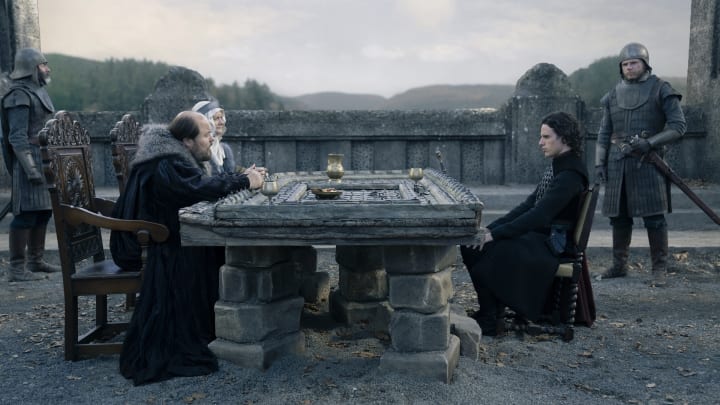
- One of the things that stood out to me the most was how good the dialogue was this season. It seems strange to say that it feels “period-appropriate”, since this is a fantasy and obviously not an adaptation of real history. But it does evoke medieval Europe, not only in its mise-en-scene, but in its dialogue too. They don’t speak like people from the 21st century that have been dropped into this medieval setting, which would feel like people playing dress-up and which viewers wouldn’t take seriously. Instead, we get dialogue that immerses us into its world and makes its characters feel like they’re a product of that environment, that they couldn’t feasibly exist anywhere else. The premise of fantasy is that it’s not real, but what makes it immersive is how much effort is invested into maintaining the illusion. Dialogue is one aspect of that illusion. A good story will make you forget it’s not real when you’re consuming it. One of the standout dialogue moments for me this season was Criston Cole’s confrontation with Gwayne Hightower in the finale, which was imbued with all the elegance and nihilism of a couple trench-bound WWI poets waxing about the futility of existence.
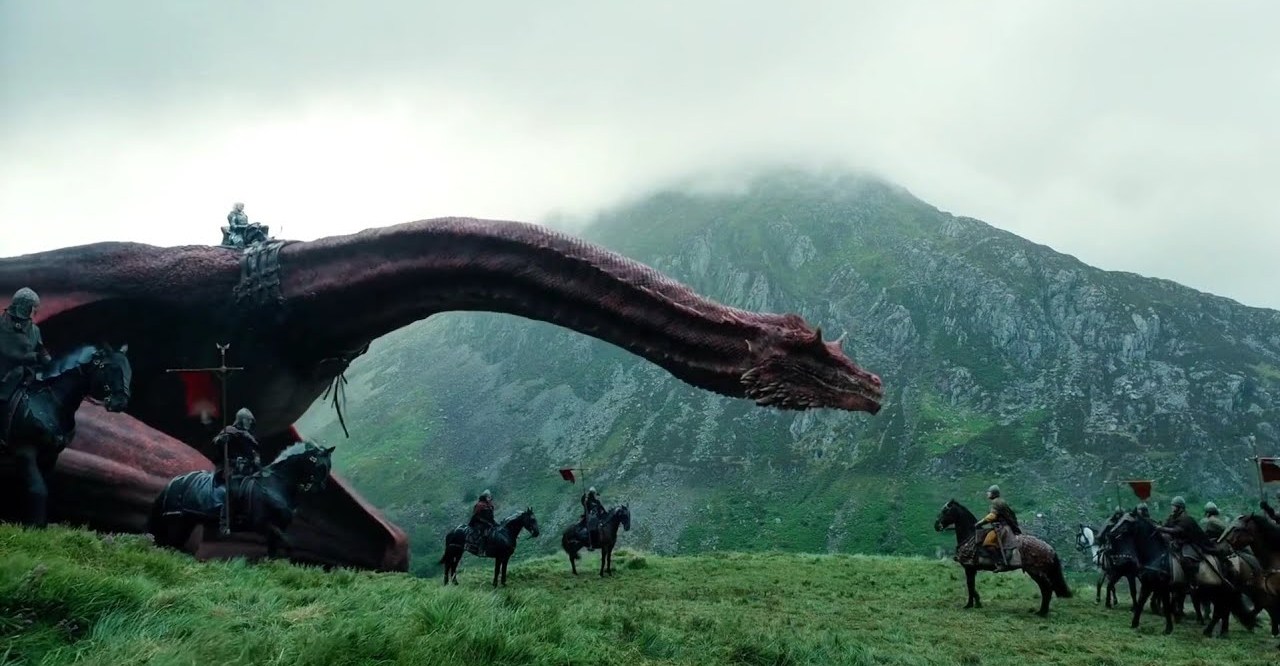
- I liked how this season showcased the depth and variety of the dragons a little more. Not only are they well-designed and visually distinct, but they have individual personalities too. In just one episode we saw a nice contrast between the more docile Silverwing and the more aggressive Vermithor. This kind of detail adds once again to that sense of immersion I mentioned in the previous paragraph, as we’re familiar with animals (such as dogs and cats) each having individual personality traits in our own world. The effort that’s been made to make them look visually distinct also serves a couple of important functions. Firstly, it helps the audience to identify which dragon is which. Secondly, it makes them more interesting—if every dragon looked like Drogon, but with a slightly different color palette, then they would get pretty boring and lose their impact as a spectacle. If we get a scene with a dragon—be it Moondancer chasing Criston Cole into the forest or Vermax waiting for Jace at The Twins—then it gives us a chance to focus on and appreciate the design of that dragon for a moment. The differences also reflect the fact that, in Game of Thrones, the three dragons we saw were all from the same litter. In House of the Dragon, we’re getting treated to a host of dragons from various origins. I also appreciated that they were made more real via the mention of logistical considerations; Vhagar can’t just incinerate armies and castles one day after another—if Aemond chooses to use her, then she has to rest for a while afterward. And the more she’s used, the more she has to be fed—which has a significant impact on their resources. I like it in fantasy when great power is offset by tangible costs and consequences.
- I really appreciated the insight we got this season into the lives of the smallfolk. Game of Thrones almost did this really well. That whole subplot with the High Sparrow midway through the show’s run was really interesting for a while, until it was ruined by the empty spectacle of Cersei blowing up the Great Sept with wildfire. All that buildup, stretching back to the riot scene in season 2 episode 6, warning at the consequences of neglecting the masses, was completely undone when Cersei blew up the seat of their religion (the most important thing in their lives) with zero consequences. Ultimately, the smallfolk had no agency and no impact on the wider story. In contrast, they seem a lot more intertwined with the narrative of House of the Dragon. Obviously, we’ve yet to see the true extent of their impact on the outcome of the war between the Blacks and the Greens, but so far they’ve already had an effect. I loved seeing the escalation of tension in King’s Landing as the smallfolk got more and more restless. Aside from the riot scenes, we actually saw them discussing the food shortage and their personal circumstances—either in their homes or at local taverns—which made them feel so much more real. This is helped by the presence of POV characters like Hugh Hammer, which emphasize that the smallfolk aren’t just a mindless herd of sheep in the background, but individuals with their own hopes, ideas, and concerns. I liked that the actions of the royal family had consequences; Aegon hanging the rat catchers wasn’t just shock value for us, but an illustration of his inexperience at statecraft. And it led to a reaction from the masses that put political pressure on the Small Council. I liked seeing the Small Council debate the optics of their actions. I liked seeing Rhaenyra, Otto, Aegon, Alicent, and others in positions of power try to court or manipulate public opinion. It all feels so much more immersive than Game of Thrones, and I hope this aspect of the show isn’t lost in future seasons when the war heats up.
- It was nice to see some of the less-established characters come into their own a little more. For much of season 1, the kids were in the background, since they weren’t of age yet to have an impact on the plot. Now that all of the time jumps are over, we can start getting to know them better and see more of what their actors have to offer. The best example of this, for me, was Aegon, who was probably my favorite character this season. Last season established him as being lazy, hedonistic, and debauched, all of which made sense given his being seventh in line for the throne and afforded little importance by those around him. That was a good introduction, but this season we really get to explore him as a nuanced, well-rounded individual. His character goes through such a range of emotions this season, and Tom Glynn-Carney does a brilliant job of bringing this to life. I loved every scene he was in. I also enjoyed seeing more of Jace, Baela, and Rhaena—I thought they were all well-acted and interesting, although none of them stood out quite as much as Aegon did.
- I also really liked the new characters we got. The standouts for me were Hugh Hammer, Oscar Tully, and Gwayne Hightower. It can be difficult for a show to introduce new characters in the midst of an ongoing conflict and make us care about them, but House of the Dragon handled each of the new additions really well. I was quickly invested in their storylines and I thought they all added some really interesting perspectives to the show’s events. In case you can’t tell from this and other blog posts I’ve written, I really don’t like it when characters are one-note. And what I liked about season 2 in general was that its characters were, for the most part, very nuanced. A lot more nuanced than their Game of Thrones counterparts in many ways. This was even true of the new characters. Gwayne starts off as haughty and arrogant, gets humbled when faced with danger, but comes out the other side with this newfound grit. I like how the power dynamic between him and Criston Cole keeps shifting—before the fighting he’s high-handed and dismissive, but once it begins, he becomes deferential. By the end, there’s an equality between them. This is a great example of a show using its screen time effectively, and getting maximum value from a minor character.
- We saw some nice character development this season for a few characters. Rhaenyra gradually becomes less idealistic and more ruthless. Daemon confronts his guilt, comes to terms with the fact he’s not great at statecraft, and accepts that his talents could be better suited to an altogether greater purpose. Alicent feels increasingly isolated and powerless, and she ends the season despondent and disillusioned. It’s telling that it’s in this context—desperate and frustrated—that she starts fucking Criston Cole. She’s lived her entire life without agency—strictly adhering to her duty, her uptight religious convictions, and her strong sense of tradition. Now that she’s feeling her life of sacrifice and obedience has brought little reward, she’s finally indulging in her own desire for pleasure—and who can blame her? Her playmate, Criston Cole, also continues to be an interesting character. He’s always wanted to be seen as an honorable knight, but it’s as if he likes the idea of being honorable more than actually living in an honorable way. It’s clear that he can’t help but give in to temptation, yet he hates himself for it. That’s interesting. He resents himself for not being the person he always wanted to be—and that’s sympathetic. Relatable, even. He feels responsible for the death of baby Jaehaerys (given that he was just down the hallway, six inches deep in the kid’s grandma at the time), and that’s why he tries to offload that guilt onto Ser Arryk, coercing him into trying to assassinate Rhaenyra. Don’t get me wrong, I don’t like Criston Cole at all—I’m just saying that he’s interesting. He thinks that if he can orchestrate Rhaenyra’s demise, then he’ll have made up for his failure. By the end of the season, he seems to have given up on his ability to do anything significant. Seeing the immense power of the dragons in action makes him feel small, and in the final episode we see him drop his pretense of dignity for the first time, and admit plainly that, despite his vows, he can’t deny himself the basic desire for companionship.
- We got the best action set piece of House of the Dragon so far in the Battle of Rook’s Rest, which I thought avoided the failings of some of the franchise’s previous battle scenes. I’d never insist that a film or show make their battles completely realistic—the only thing that annoys me as a viewer is when there’s something so unbelievable that it breaks my immersion. I hated the Battle of the Bastards in the main show, which I thought perfectly encapsulated the franchise’s reliance on empty spectacle and deus ex machina. We saw it in the Battle of the Blackwater, the Battle of Winterfell, and even in House of the Dragon with that nonsense at the Stepstones last season. We can do better! So much better. The Battle on the Wall was proof of that in the main show and the Battle of Rook’s Rest showed that in the spin-off. It doesn’t have to mimic real-life history to be believable—we just need decisions to make sense in context. We can feel a sense of narrative tension and peril without insurmountable odds being overturned at the last second by armies appearing out of nowhere. I thought Rook’s Rest was done fantastically well. Cole’s plan to draw out Rhaenyra makes complete sense. It might have been more volatile than he’d anticipated, but you can see what he and Aemond were thinking. Aegon riding Sunfyre into battle also makes sense—he’s still traumatized by the murder of his son, he’s drunk, and he’s frustrated at the way everyone is sidelining him. He’s desperate to avenge his child and to prove to everyone that he can lead. Rhaenyra sending Meleys makes sense too—she’s under a lot of pressure to act, and, so far, Cole’s force has been unaccompanied by a dragon. So the context is perfect. The execution matches it, and I loved seeing the perspective from the ground of the dragon fight above. You get a real sense of terror and helplessness from Cole’s soldiers. The presence of dragons turns out to be far more destructive than Cole had anticipated. This reflects the way many people, Cole included, are used to the sight of dragons, but have never seen them in battle. It’s absolute chaos, and it’s all Cole can do to keep his men from fleeing into the woods. I also loved the way the dragon fights were filmed, mimicking the way birds of prey in our own world go at each other in the air. It was such a crazy improvement from the abysmal dragon fight we got in season 8 of the main show. The only real downside it had was that it seems a little unbelievable that a dragon as big as Vhagar could remain undetected like she was before ambushing Meleys. At the time, I didn’t think anything of it, given the way the riders were breaking apart from one another and then circling back around. Overall, it was a minor imperfection from an otherwise excellent scene.
- Following on from the last point, I like the emphasis on the consequences of using dragons for violent purposes. After the battle, the likes of Criston Cole and Gwayne Hightower are changed men. It adds to the sense of immersion that they and their soldiers might have PTSD from seeing people get incinerated in the blink of an eye right next to them. It also mirrored nuclear deterrence in the way leaders were careful about deploying dragons for fear of escalation or in-kind reprisal, which I thought was a nice touch.
- Lastly, I’d like to highlight what I thought were the season’s best scenes. We’ve already covered Rook’s Rest, but equally well-executed scenes were Blood & Cheese, Otto being sacked by Aegon, Baela’s speech to Corlys, the Red Sowing, Oscar Tully resolving the Riverlands crisis, and Daemon’s submission to Rhaenyra.
The Worst of House of the Dragon Season 2

- Daemon’s storyline honestly represents both the best and worst aspects of season 2 simultaneously. For me, the whole is better than the sum of its parts. I love his character development this season, and how it factors into the overall story. Where his storyline ends is fantastic—where it lets itself down is how it gets there. I didn’t find it very entertaining on a moment-to-moment basis, and I think it could have been improved by adding in more political maneuvering at the expense of some of the dream sequences. For me, dream sequences are best when used sparingly—it’s inevitable that having too many scenes that are patently unreal will leave an audience feeling disengaged. I’d have restricted his storyline to two major weirwood dreams for the season—one looking backward to his regrets and the other looking forward to his renewed sense of purpose—and then fleshed out the intrigue in the Riverlands. Matt Smith’s Daemon is such a dynamic character that commands a great sense of stage presence, so it feels like a waste not to have him interacting with other people and being an active player in all the politicking. The subplot with the Blackwoods and the Brackens could have been a lot more interesting to watch in my opinion. Daemon tells Willem Blackwood that he can’t get directly involved, but sanctions him to move against the Brackens. This came across as confusing, since the two houses were already in open conflict to the point of sending soldiers to battle against each other. So what effect did Daemon’s sanction have on what was already going on? And what was the point in him not being directly involved if everyone in the Riverlands blames him for it anyway? None if this is conveyed in a clear way. On a macro level, Daemon’s storyline is great—it’s the details that let it down.
- Rhaenyra sneaking into King’s Landing to treat with Alicent echoes some of Game of Thrones’ worst writing choices. In Game of Thrones’ later seasons, we saw plenty of plot points that were shoehorned into the narrative out of a contrived attempt to put certain characters on screen together. Tyrion sneaking into the Red Keep to treat with Cersei, the inexplicable showdown where Missandei is executed on the city walls in front of Dany, that entire ridiculous storyline of bringing a zombie down to King’s Landing—none of it a natural progression of the story, or a believable set of actions from the characters. House of the Dragon so far has never been quite that bad, but you can see that same instinct creeping in, as though some executive at HBO told them they had to have Emma d’Arcy and Olivia Cooke share a scene somehow. This happens twice this season—but the first instance, where Rhaenyra engages Alicent in the Grand Sept, is the more outlandish. It’s not as egregious as any of the aforementioned contrivances of Game of Thrones, because it’s not entirely out of character. We know that Rhaenyra is impulsive, daring, idealistic, and that she has a high degree of risk tolerance—these are core attributes to her character that we’ve seen from the very beginning. It also makes sense that she, like many other characters on both sides, wants to avoid unnecessary bloodshed and the widespread destruction that would result from all-out war. Nevertheless, I found the idea of her sneaking into King’s Landing simply too preposterous—even someone as bold as Rhaenyra should understand how the risks in such a venture far outweigh the rewards. To me, it detracted from the impact that their reunion might have at a later date. It would be more effective, I think, to have them cut off from each other this season, and then find themselves suddenly face-to-face in a more unexpected scenario. Say, for example, Rhaenyra takes King’s Landing at the beginning of season 3 and finds that Alicent didn’t flee the Red Keep—imagine how much more interesting and impactful that reunion would be had they not been sneaking over to each other throughout season 2. I think Alicent’s visit to Dragonstone in the finale wasn’t as bad, given her character development this season. She’s obviously in a desperate place at this point and it makes sense that she’d want to plead for her children’s survival. What makes less sense to me is that she would give up Aegon like that—especially given the guilt she must feel for being so harsh toward him before his injury. It makes a lot more sense to me for her to insist that Rhaenyra accept Aegon’s abdication, and for Rhaenyra to begrudgingly accept (even if she doesn’t honor it later).
- I like the idea of Rhaena finding Sheepstealer, but I didn’t like the execution. I found Rhaena’s character interesting; how she wants to be given responsibility like Baela, to help her family, and to have a dragon of her own. Her frustration at being put on babysitter duty was compelling. To have her get what she wants, but in an unexpected, roundabout way—in the form of a wild dragon—is good writing. I just wish she came across Sheepstealer more naturally. I don’t buy her wandering off into the wilderness and abandoning her duty like that. You would also think her disappearance would be noticed very quickly. It makes sense that the dragon, if it is wild, would be hard to find, and living up in the mountains—but it doesn’t make sense for Rhaena to just go off in a random direction and live off the land. Maybe they could have had her asking people in the Eyrie for information, and eventually discovering that it has a nest somewhere. It would make sense that farmers and local villagers would have gradually picked up on where Sheepstealer tends to hang out, and perhaps it’s a place they avoid for obvious reasons. Then we could have Rhaena seek out Sheepstealer in a more targeted way. Maybe local farmers complain to Lady Jeyne Arryn about a wild dragon picking off their livestock, and Rhaena follows up with them after the fact, and goes with them in an attempt to draw Sheepstealer out and tame him. That would add more tension between her and Lady Arryn as well. I feel like, with very little extra effort, Rhaena’s storyline could have been more coherent, interesting, and complete; beginning the season feeling powerless and glum as she’s sent away to the Eyrie, trying to treat with Lady Arryn but being rejected because she can’t offer a fully grown dragon as protection, almost giving up on her ability to contribute to the war effort, then seeking out Sheepstealer, taming him, and returning to the Eyrie on dragonback, forcing Lady Arryn to send the Knights of the Vale to Harrenhal. That’s a complete arc right there! It would tie in nicely to the finale ending with the various houses marching to war, and it we’d see Rhaena start the season as a helpless girl only to finish it as a confident woman.
- I do wish we had more reactions on the Green side to Aemond killing Lucerys. It’s easy to forget that the Greens and the Blacks are one family. I wanted the show to emphasize the taboo of kinslaying a little more, as illustrating how seriously these cultural values are taken would both add more weight to events and heighten the sense of immersion. There’s also the fact that killing Lucerys has massively escalated an already volatile situation, making a diplomatic solution far less likely, and guaranteeing a violent response. It would have been nice to get callbacks to this later in the season as well, maybe after the Battle of Rook’s Rest, with Alicent commenting that Aemond’s reckless behavior at Storm’s End has pushed the succession dispute into all-out war. It would help contextualize the sequence of events for the audience, especially given that the killing of Lucerys happened last season and won’t be fresh in the memory for viewers. I liked the scenes we got of Aemond at the whorehouse, where we get a glimpse into his guilt. I wanted a bit more of that. While it does make sense for Aemond’s character to want to appear strong—and that, rather than admitting his mistake, he doubles down and embraces the monster label given to him—I don’t want him to actually become a monster. I like the idea of him repressing his guilt and gradually shedding his humanity in response to the way people treat him, but if he just becomes evil then that cheapens him. While it’s right that Alicent is shocked by the killing of Lucerys, I feel like she gives up on Aemond too soon and just decides he’s this psychopath that’s too far gone. But not too much time has passed since that event. It seems a bit sudden to me. The most important aspect of Aemond—his constant—is that, deep down, he’s still that bullied, humiliated kid. He dresses that vulnerability in hard layers, but it’s there. I just hope that this isn’t forgotten going forward, otherwise he’ll end up a boring caricature.
- One thing I missed about the previous season was that it had more dynamic, big-group dialogue scenes that led to some nice interplay between its colorful cast of characters. It felt a lot more like a family drama—a lot like I, Claudius in fact. It seemed that every episode there was a banquet, a funeral, a wedding, or a royal hunt where we got to see almost the whole cast share the screen. Of course, it makes complete sense why we don’t get these memorable scenes in season 2. Firstly, the war has begun, and so the Blacks and the Greens are now separated from each other. Secondly, the first season had a fundamentally different pace, given that it spanned many years to cover the build-up to the Dance of the Dragons. This meant that season 1 functioned as a kind of highlight reel of the most significant events. Season 2, on the other hand, is paced in “real time” for lack of a better term, with each episode flowing seamlessly into the next. That means that we have to build up to the next big moment with character development instead of jumping straight to it. So many big moments happening one after the other in real time would give you whiplash. There needs to be buildup and reaction to give them the intended impact. Season 1 was able to avoid this with time jumps, and because the audience understood that the real conflict—the Dance of the Dragons—was yet to come. There are also logistical considerations as well—it takes time, in-universe, for all of the various factions to mobilize their armies. It takes time for Daemon to unite the Riverlands under his banner, or for Tyland Lannister to travel to Essos to acquire the fleet of the Triarchy. Where season 2 struggles, I think, is making effective use of this time. Since this is a TV show, they need to have the likes of Emma d’Arcy and Matt Smith on screen, even if the circumstances of the plot place tight restrictions on the actions available to them. It’s a tough job, but like I said, I do think the show could have made Daemon’s storyline more compelling. We get some really good character development in season 2, but given the difference in circumstances, it’s undeniable that season 1 had more memorable scenes. I don’t mind that we ended season 2 where we did, with the various factions marching to war, but I do wish they’d made the political maneuvering on the way a little more interesting. If not political intrigue, then perhaps some personal drama—a little romance or something—would have been a good idea.
The Unfair Criticisms of Season 2

- In many ways, season 2 of House of the Dragon is a strange one to review. I think that’s in large part due to the inherent challenges of the source material, which is a fictional history rather than a traditional story. A novel would be easier, as it would have clearly defined POV characters and a plot built around their respective arcs, meaning that they would appear consistently and always have something to do. A novel would also mean that you wouldn’t have a difference in pacing the way you do between seasons 1 and 2 of the show. In a fictional history, you can do that—covering only the important events and skipping years between. You can have characters become consumed with grief for months on end and then reappear later. You have this incredible freedom to make it a lot more akin to real life. In a novel, or indeed a TV show, you can’t do that. So the writers of House of the Dragon had to look at the source material and find the potential for a story there. Think of it like real history; if you’re making a documentary or writing a history book about the dissolution of the Roman Republic, you have complete freedom to cover as many of its events as you want, from beginning to end, in as much detail as possible, and from an omniscient perspective. If you’re writing a novel, play, TV drama, or film about the dissolution of the Roman Republic, then you have to extract a story from that history. Is it going to be Julius Caesar’s story? Mark Antony’s? What are the themes you’re going to work with? What’s are the character arcs? You can’t be everywhere and cover everything. I think adapting Fire & Blood into a TV drama is a little similar. It’s why we have all those time jumps in season 1 and characters seemingly treading water in season 2. I’m not trying to tell people what they can and can’t critique, I’m just saying that some of the discourse around House of the Dragon season 2 seems a little unfair given the unavoidable challenges the show’s writers have had to navigate. I’ll explain what I mean in the following points.
- House of the Dragon is an adaptation. I think sometimes people lose sight of what an adaptation is. The key is right there in the word “adapt”. Change is an inherent part of adapting something. You’re taking a story and tweaking it to fit a new format that comes with its own constraints. What constitutes a good adaptation isn’t fidelity to the source material; it’s how well you make those changes to ensure that the spirit of the source material can be told in a new way. I recently went to see a stage adaptation of The Grapes of Wrath. Obviously, it had to streamline the events of the novel, but it worked because it still conveyed its themes of perseverance, family, powerlessness, community, exploitation, and dehumanization. The reason Game of Thrones failed so spectacularly wasn’t simply because it deviated from the books. We accept changes as part of the adaptation process. The reason the show failed was the way it went about those changes. Benioff & Weiss undoubtedly had a tough task, given that they’d run out of source material, but they still made poor creative decisions where there were viable alternatives. There was a lot of room, still, to go about things differently and have a streamlined Game of Thrones that made sense and paid off its various long-running arcs. With House of the Dragon, I feel like there’s less room for viable alternatives in my opinion. One thing that’s really important to note about season 2 is that it was planned to have 10 episodes, but due to Warner Bros’ financial problems, HBO were asked to reduce this to 8 episodes relatively late in the process. So this isn’t a creative decision—this is a logistical constraint placed on the writers, who had to rework their 10-episode arcs to fit 8 episodes. We also had one of the biggest writers’ strikes in the industry’s history, which meant that the writers couldn’t tweak or rewrite any of the scripts while the show was filming. It feels like such lazy criticism when fans mock the likes of Ryan Condal and Sara Hess, because all sense of context is ignored. It’s clear that they wanted a 10-episode season that ended with the Battle of the Gullet, but were forced to cut corners. It’s not the same as Benioff & Weiss having Arya kill the Night King or Daenerys going out of her way to murder innocent civilians, because those decisions weren’t forced by external circumstances. They were purely creative choices. The absence of the Battle of the Gullet in season 2 isn’t a creative choice; it’s an unfortunate logistical necessity.
- One question I saw fans asking a lot was “Why can’t the Reach just supply King’s Landing during the blockade?”, but this criticism doesn’t hold up for a few reasons. Firstly, it assumes that the Reach has an infinite supply of grain that can just handle any burden. The likelihood is that it’s already sending as much as it can via land and is probably at its limit already. Prior to the blockade, it’s just as likely that the Reach sent grain to the capital via the sea rather than by wagon. Throughout history—and especially during ancient and medieval times—boats were the most efficient way to transport things in bulk. There were no freight trains or articulated lorries. In order for Ancient Rome to support its enormous population, the city relied on maritime trade. The surrounding farmlands wouldn’t have been enough to feed a city that reached over a million inhabitants back then, and they were dependent on grain imports from places like Egypt and Sicily. During times of conflict, that dependency was often exploited to exert political pressure. It’s the same with Rhaenyra’s blockade of King’s Landing. It’s not that the city has no food, it’s that without overland supply in conjunction with maritime imports, enough scarcity is created to cause panic and political chaos. I really liked this subplot because it mirrored real history. Even the way Rhaenyra sends food to the starving population had a ring of truth to it, capturing the way political leaders will offer solutions to problems they themselves created, in order to curry favor or manipulate public opinion. We should also mention that a lot of livestock is going to Vhagar, on account of Aemond using her in combat more.
- I thought the backlash to Rhaenyra and Mysaria’s kiss was a bit strange too. To me, the series could use a bit of spice. Interpersonal drama and romance are good ways for a show set during a war to add tension and excitement between the battle scenes. There are the usual morons complaining that the kiss is somehow “forcing an agenda”, as though just showing gay characters on screen will somehow turn straight viewers gay themselves. Why HBO would want to do this is anyone’s guess. It reeks of fear and insecurity if you ask me. It’s disappointing that the franchise still has enough homophobes tuning in to cause a fuss, given that the books, the main show, and the first season all have a strong track record of gay characters. It’s nothing new. Some complaints have said that the kiss didn’t make sense, that it felt contrived, or that it should have been telegraphed beforehand. I’m not so sure. I think it was meant to be sudden—both for us and for the characters themselves. It makes sense that both characters are feeling vulnerable, lonely, and starved of real intimacy. Especially Rhaenyra (who we know from season 1 has quite the libido). I think it’s natural for certain personality types to jump at the chance for physical intimacy during moments of high stress. It’s also a reflection of the way the two characters have bonded throughout the season over the difficulty of achieving agency in their world as women. So I don’t think that the kiss would have been made better by flirtatious glances beforehand or anything. I like that it was an unexpected expression of passion between two people that obviously needed it. However, I do think that the kiss can be ruined in retrospect. I’m not expecting it to develop into a relationship or anything like that, but if it goes completely unacknowledged then it will feel a little strange.
- The last criticism I think we can categorize as unfair is the whining about the lack of battle scenes. It seems that some fans thought that since the Dance of Dragons is a war, that we’d be getting big battles every other episode. In the words of Roy Keane, you’re living in cuckoo land. That was never feasible, even with a 10-episode season and an inflated budget. Logistically, big action set pieces like the Battle of Rook’s Rest involve an astronomical amount of work. It takes them a long time to produce and it’s expensive too. From a narrative standpoint, it wouldn’t make sense either. To have the intended effect, action set pieces need the appropriate buildup and reaction either side. Too much action would lack any dramatic impact. Remember, we got very few battles in Game of Thrones considering the scale of the so-called War of Five Kings. We never saw the Starks and Tullys fighting against the Lannisters, but we understood well enough that this was happening in the background. The quality of those first four seasons was great, and it didn’t need to rely on spectacle.
Conclusion & Look Ahead

Overall, I thought that it was a good, albeit imperfect, season. It was clear that it didn’t turn out quite as they wanted it to, but I think the writers handled the challenge of adapting their 10-episode blueprint to an 8-episode one as competently as could be reasonably expected. I’d say that season 2 did some things better than season 1, and some things worse. It doesn’t reach the heights of seasons 3 and 4 of Game of Thrones, but it by no means approaches the lows of seasons 7 and 8. In many ways, season 2 of House of the Dragon is kind of unique in terms of its strengths and weaknesses, probably because of the unique creative journey it went on behind the scenes. There was nothing so cringe-inducingly bad that it broke my immersion, like that godawful Ed Sheeran cameo or Daenerys’ implausible rescue of Jon Snow at the frozen lake. In many ways, House of the Dragon is more mature than the main show. But it can’t be denied that peak Game of Thrones had some color to its cheeks that’s lacking in the spin-off.
All this is to say that season 2 of House of the Dragon kept me entertained the whole way through, and never did anything in particular to spoil my enjoyment or sense of immersion. However, I do feel like there could be problems next season. The indication at the moment is that they will continue to do 8-episode seasons, and that they’re still committed to finishing the show in four seasons. That’s a lot of story to get through in just 16 episodes. Obviously this could change, but I find it unlikely that they’ll revert to 10 episodes a season, or extend the show’s run to a fifth season. As it stands, it’s going to be 8 episodes for season 3, 8 episodes for season 4, and then that’s it. I’m worried that both seasons 3 and 4 will feel rushed, with little character development between the big moments. Hopefully they don’t have people teleporting around Westeros the way they seemed to in Game of Thrones’ latter seasons, but I wouldn’t be shocked if little contrivances like that start to creep in here and there. We’ll have to see how it all pans out. I’m expecting character storylines to be merged and a couple of battles to be condensed into brief montages. Whether it will work, I have no idea.

 TumbleweedWrites