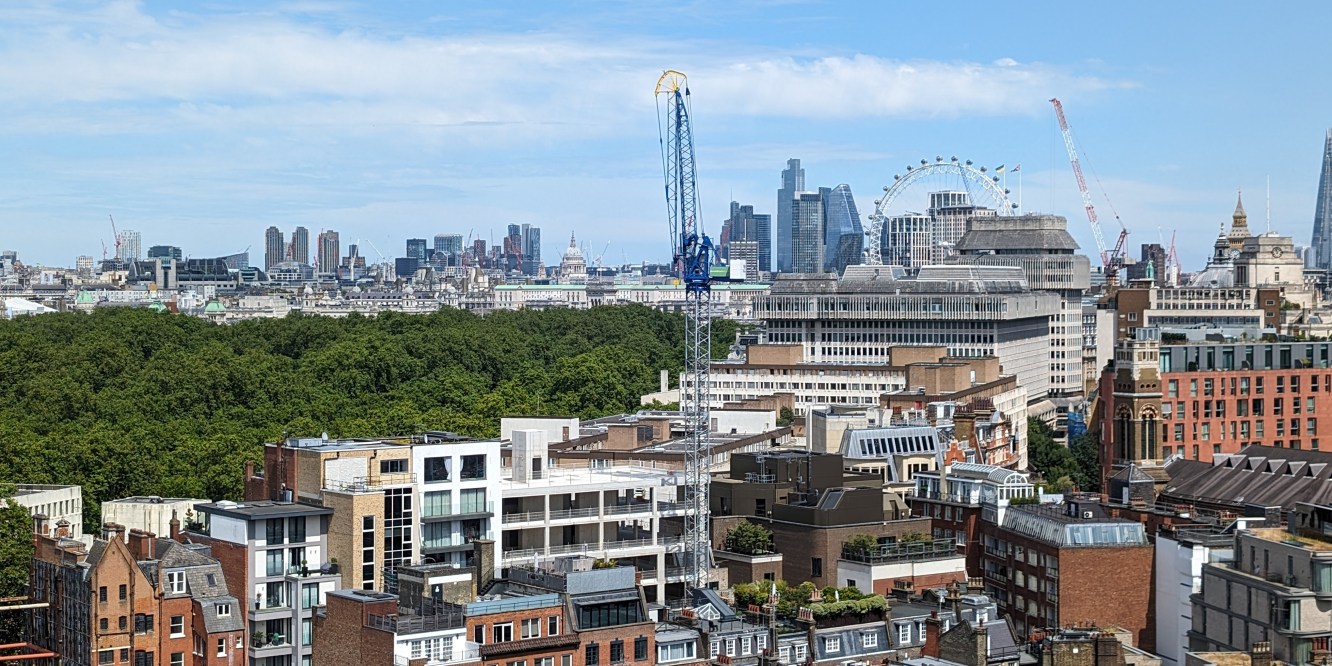
It’s crazy to think that I’ve lived in London for almost three years now. It seems like just yesterday it was 2019 and I was washing dishes for a living. It was a different world. There seemed to be no forecast for any great change. I looked ahead and saw only more dishes that needed scrubbing in my future. The server that brought them to me would change through the years, but I’d still be there in my little corner, the passive, silent workhorse that can conceive of nothing else except ploughing endlessly ahead until death.
I couldn’t have imagined that in a few short months the pub would close its doors due to a global pandemic. I certainly couldn’t have imagined that on the other side of that pandemic, I’d be living in London. That I’d emerge from it with a career, a house, a master’s degree, a published book, and a bunch of new friends in whose company I felt like my authentic self. Not a chance! London wasn’t even a thought back then. Not even a dream. In many ways London was the offspring of the pandemic.
It feels like a long time ago now, when London was just a vague idea induced by the lockdown. And even longer ago, when it was nothing at all.
With that in mind, I thought it might be interesting to look back on the journey so far and record my thoughts about living here. Naturally, these observations are reflective of my personal experience; I’m only attempting here to document the city as it exists for me, and not to provide some objective portrait of universal value. Alright? Let’s go.

- Obviously there are many routes into London, but I definitely feel like coming as a student makes relocating your life here so much easier (especially if you’re young or don’t have much work experience). It simplifies the whole process and means you don’t have to juggle all these stressful things at once. At first, I didn’t plan to go back into education. I was already worried about wasting my 20s and I just wanted to get a career and a place of my own as fast as possible. But in retrospect, I don’t know if I’d have been able to relocate here successfully if it weren’t for my master’s. I feel like my Publishing MA was less a ticket to the publishing industry and more simply a ticket to London. It got me what I wanted—there’s no doubt. As a student living on campus, I had a guaranteed place to live that was super cheap. No utility bills, no council tax, no forms or contracts to worry about. Being a student meant that I met a lot of people, all of whom were also keen to connect with others. That meant I had people to get a house with after we graduated, instead of taking a chance with strangers found online. In short, arriving as a student meant that I could focus on one thing at a time, in a relocation process that was less risky, less stressful, and less sudden.
- So far, I’ve discovered London very gradually, one neighborhood at a time. Most of the city is still a mystery to me, and I expect it to remain so for a very long time. Even if I end up staying here for the rest of my life, I don’t think I’ll die feeling that I know it in any complete sense. I think it will always feel unconquerable, perpetually out of reach. That’s one of the things I like best about living here—it’s perennial newness. I don’t like small towns, I know that. Living in a big international city feels like the closest I can get to being constantly on holiday. I have only to turn onto a new street or exit the subway at a new stop and I’m elsewhere. I like that I can be elsewhere so quickly, with so little effort. Obviously I don’t always make use of this in my free time, but I like knowing that it’s all there, that I’m surrounded on all sides by otherness. So far, I’m enjoying discovering London piece by piece. One café at a time, one cocktail bar, one bookshop, one city park.
- If we’re to liken my presence in London to an infection slowly poisoning the city, then the root of it started in Kingston-upon-Thames. That’s where I went to get my MA and where I lived for my first year. Technically it is a part of London, but it’s right on the edge. It doesn’t have a tube station and it feels quite self-contained, almost like it’s its own town. So moving there really was the epitome of easing myself in to the city. Kingston is quiet, affluent, and leafy—with wide, sylvan streets and an old-fashioned market square in the town center. Its identity seems dominated by two things: the university and river. The commercial nucleus is a bustling place, full of noise and activity, but within the blink of an eye you can find yourself in its deserted residential neighborhoods; quiet streets presided over by chubby cats with milk-white fur and lazy eyes. Altogether it has more or less everything you could need. On the Thames you can go paddleboarding, rowing, sailing, or kayaking. The Rotunda has a pretty cool bowling alley, gaming arcade, and Odeon cinema. When it’s warm you can go to Fairfield Park for a kickabout or a picnic. There are street food stalls in the market square, cozy cafes in vaguely medieval alleyways, and the mall has a nice Waterstones. In December there’s a fat Christmas market that’s very much worth seeing. Another thing I really liked was the Riverside Walk, where there’s a nice string of places to eat and drink overlooking the Thames. I’m especially fond of The Mill and The Ram, two Riverside pubs that I liked going to with my friends. And perhaps my favorite place of all in Kingston also lies on the riverfront, Poor Boys—which is a Cajun restaurant known for its frozen margs and long queues that stretch all the way down the canal to the river.

- During my first few months in Kingston, something I used to do a lot was imagine what my life would have been like if I’d done my undergrad there. My own undergrad experience at Winchester had been lonely and disappointing—it was a very low period in my life where I was so focused on minimizing pain that I never took a chance on anything. I never left my room, never made any memories, and the whole three years felt like a waste. Because of that, I’ve always been curious about the lives and memories of other undergrad students. Their late-night conversations, their group politics, their messy romantic entanglements, their crazy adventures. What was everyone else doing after I went to bed early every night? I always imagine that everyone else’s undergrad memories take place during nighttime, that undergrad students are nocturnal creatures. Part of me wanted to live out the undergrad life I missed out on when I returned to Kingston as a master’s student. To a very limited extent, I did. But mostly I just imagined scenes from undergrad lives when out and about. At The Mill, I imagined someone playing pool with their friends and suddenly seeing their ex on a date with someone new, sitting at a table by the Thames-facing windows. At Fairfield Park, I imagined two people walking home in the pitch dark at 3am, then stopping for a serious conversation. In the King’s Tun Weatherspoons I imagined someone pre-drinking with a rowdy group of friends, and all the hopes, fears, and expectations they had for the long night ahead. The time this feeling struck me the most intensely was when I was walking through a small set of student dorms called Middle Mill with my friends at 11pm. In the dark, it fascinated me. We all remarked how it was nicer than our own dorm at Clayhill, situated on a small canal running through the heart of Kingston, its buildings made of pale bricks and giving the impression of a repurposed watermill. The dorm buildings formed a box around a central square, and at once I started imagining the stories of those that lived there. Small groups of smokers lingering by the doors, a first kiss up against the canal railing, someone walking in slow circles around the square during a sad phone call. Always in the dead of night.
- I liked living in Kingston during my first year of London, but I wouldn’t say I’m especially nostalgic for it. At first it was new and exciting but before long I started to crave something closer to the heartbeat of the city. You don’t necessarily feel like you’re in London when you’re there, at least not the London of popular imagination. I think I like to be in places that are on a big scale, with a lot of everything; busy, bustling places where you’re completely anonymous, where it feels like important things are happening. Kingston has a slower pace and more of a community feel. By the time my master’s ended and I left the dorms, I felt a strong desire to distance myself from the place for some reason. I was reticent to go back to Kingston and I wanted to continue my north-east trajectory, throwing myself into the lap of the city.
- Since leaving the Surbiton-Kingston area, I’ve been living in Wimbledon. I much prefer it! As soon as I arrived here, I really liked it, and that feeling hasn’t changed two years later. It feels a lot more like London than Kingston. You’re closer to the heart of the city, and that’s reflected in the landscape, amenities, and general atmosphere. I like that I have quick and easy access to the rest of London while living here. Wimbledon feels very connected to everything outside it.
- What there is to see in Wimbledon exists on this axis between Wimbledon Common in the west and Morden Hall Park in the east—both of them being big, open green spaces that bookend a long road filled with all kinds of urban amenities. I feel like I’ve gotten to know this axis really well and I’m still not bored of it. My favorite pubs include The Old Frizzle, The Nelson Arms, The Prince of Wales, and The William Morris. There are some amazing restaurants, such as Al Forno, Diba, Mai Thai, 601 Queen’s Road, and Imm Thai Fusion. My roommate and I love going bouldering together at The Boardroom or catching movies at the local Odeon with a couple Tango Iceblasts. In so many ways, this axis feels like home.
- Other places I’ve gotten to know a little include Kilburn, Brixton, and Greenwich. Kilburn I didn’t like because it seemed a little quiet and boring for my tastes, as though it were far removed from what’s going on. Brixton seems vibrant and full of character—I liked seeing the quirky little arcade markets and second-hand stores. It had a nice sense of atmosphere. I’ve been to Greenwich a few times now on account of my friends living there and I really like it. It’s got wide, pretty streets, a lot of greenery, and it seems like there’s a good amount of stuff going on. My friends took me to a pub called The Gipsy Moth that I really liked, and I love Greenwich Park too. Overall, it has nice scenery and seems chill without being boring.
- I went to Richmond for the first time recently, which I also liked. It seemed different, like it was this giant, wooded hill disconnected from the rest of London. That it had its own rhythms and was insulated from the hustle and bustle around it. It felt more posh but less busy than neighboring Kingston, with narrower, more winding streets. My friend and I ate steak at a boujee Australian restaurant, visited The Open Book bookstore, and checked out the wild deer at Richmond Park. I have no idea what it would be like to live there—it has nice scenery, but I wonder if I’d prefer somewhere better connected to central London.
- The worst thing about London is the cost of living here. To say that the rent amounts to extortion would be an understatement. You get little for what you give—and you give a lot. The prices of everyday goods and services are also more expensive than they would be elsewhere in the UK. Council tax chews at your nutsack every month, humbling you right after payday. London is kind of a paradox for young people; it’s not set up for them to afford living there, but it’s so often the best place for them to find work. Obviously it varies from field to field, but London is crucial for getting started in a lot of industries. When it comes to career jobs, London feels like a necessity—so it attracts disenfranchised millennials like moths to a flame. The government could implement various reforms to ensure young people don’t burn—but that would mean them having the courage to break out of the ideological stranglehold neoliberalism has had on the political center-ground since the 1980s.

- Central London is a place of contradictions. Plush skyscrapers with glass facades sit alongside medieval chapels. People cross the road from their newly erected fintech office for leaving drinks at a pub that predates the industrial revolution. Delivery drivers on e-bikes share the road with Aston Martins; commuters in high-vis jackets share the tube with commuters in three-piece suits. People almost trip over homeless sleepers on their way to matinees, happy hour cocktails, or work-sponsored axe-throwing sessions. Doormen in top hats stand across the road from foxes sniffing at scrunched-up paper bags containing traces of long-since discarded Greggs sausage rolls. Monuments to imperialist slave traders stare remorselessly down from granite plinths at the descendants of their victims. Rooftop pools and terrace bars sit several stories up from techno clubs and tantric massage parlors. Russian oligarchs watch from tinted windows as lads howl at the moon about forever blowing bubbles like tattooed East End lycanthropes. I know that different worlds existing in the same space is a feature of every urban environment, but London is a city where those juxtapositions feel more pronounced. You see the polar extremes of decadence and destitution at every street corner.
- The contradictions I mentioned above are what strike me most about London. Other than that, it’s not a city with much of a visual identity. It’s such an architectural mess that there’s no aesthetic consistency, and I feel that consistency is what builds atmosphere. I love living in London, but it’s not a place I romanticize. I don’t want to read books set in London or look at paintings of the city. I feel like my attachment to London, though strong, is not sentimental in character. It’s more about the rhythm of the city, the interconnectedness, the scale of it. To look at, I think London is kinda ugly. To live in, it’s a blast.
- London can be quite a lonely place to live. I think the reason for that is simply the cost of living here. People don’t tend to live near their friends, because rent is so expensive that you just have to snatch up whatever place you can afford as soon as possible. So the average group of friends live all over the city, meaning that they can’t just meet up spontaneously for a chill drink or whatever. It’s different when you’re a student living with your friends on campus, and you can just drop “Spoons?” in the group chat. For young professionals, a typical social gathering in London is something you have to plan in advance, that takes up the better part of your day, with most people traveling for about an hour. There isn’t the same café culture you get in the cities of mainland Europe, where friends might live in the same neighborhood and be able to hang out on a more casual basis. Transport, food, drinks, tickets; the costs of hanging out with your friends in London add up—and catch you off-guard when you check your bank statement later. What this means, in my experience, is that you see people less often, and in less casual circumstances. If you looked at my Instagram stories, you’d probably get the impression that living in London is vibrant and exciting, that I’m an absolute chad on wheels. But the truth is I only see my friends occasionally, when all the various factors align; most evenings I’m watching competitive Age of Empires 2 while eating ice cream and trying not to dwell on my failings.

- London shapes the dating scene in much the same way. Making time for dates and allocating a budget for them is no small commitment. As a good friend of mine from Greenwich recently quipped, “There’s only so many times I can take my girlfriend to the maritime museum”. The average date in central London consists of going for cocktails—that’s at least £10 per drink, and you’ll probably get 2-3 drinks at a minimum. If you’re going for food as well, that’s likely another £20. Starter? Forget about it. Yeah, sharing platters are cute and all but you already booked tickets to see Hamilton with your parents, you preordered the new Elden Ring DLC, it’s your best friend’s birthday next weekend, and you’re subscribed to about three different streaming services. You’ll be ruined, mate. Even if the date goes well, it’s not like the movies where the momentum you built up in the cocktail bar seamlessly cuts to you stumbling up her apartment stairwell in a manic three-legged race. The reality is that if you’re going to inspect the contents of their sweaty undercarriage, there’s going to be 45 minutes of awkward silence on the tube where all tension is deflated. Then you’re just a random donut lingering impotently in her kitchen, making clumsy small talk about her cat, already sobered up. But statistically you’ll never get to that point anyway, because the date that set you back £50 ended with a rushed hug at the bus stop and the mutual realization that you’re fundamentally incompatible. She murmurs she’ll call but she doesn’t make eye contact. You get home, feel a swelling in your temple that you know from experience will be a headache once you wake up, and go to bed with the sense that other people are essentially unknowable. Okay, I’m generalizing a little bit, but I’m just trying to show how for ordinary young people in London, the cost of living makes simple things like dating much more of a commitment. You often have to prioritize one thing in life over another, and whatever you do, the effect on your bank account will always linger in the back of your mind while you’re doing it. Young workers in London have to be selective, purposeful, and restrained.
- Despite its high costs, there are a few ways to have fun in London on a budget. The first and most obvious free activity is going to museums. Obviously there will be costs that go around it, but the museum itself is often free (or at the very least, affordable). Another thing I’ve really enjoyed since living here is going for picnics with my friends in city parks. One of the best things about London is that it has a lot of green spaces. All you have to pay for is the transport and the food and drinks you bring. So there’s a little cost, but compared to other ways of hanging out with your friends in London, it’s very affordable.
- On the more expensive side of things, my favorite thing to do in London is going out for dinner with my friends. I mentioned some of my favorite restaurants in Wimbledon earlier, but there have been so many cool places I’ve been to throughout London. So many meals that have become fond memories for me. The succulent kleftiko lamb at Andy’s Greek Taverna in Camden for my friend Lucia’s 28th birthday. The steak I enjoyed with Emily at Antipodea in Richmond. Being taken to Sodaeng in Putney on my 30th birthday and grilling the meat ourselves on the table. Creamy pasta followed by the best tiramisu I’ve ever had at Taverna Trastevere in Clapham with my work bestie. The delicious pulled pork at Cubana Bar in Waterloo before hitting up Swiftogeddon. And how can I forget the softshell crab and Cajun fries at Poor Boys in Kingston? My goodness. My real goodness! London is an incredible city for going to restaurants—it reminds me of Houston in that way (perhaps the only similarity those two cities share). There’s always somewhere new to explore.

- I think the stereotype of Londoners being unfriendly isn’t quite accurate. It’s more that the atmosphere feels less warm, because life in urban places tends to be more atomized and less communal. And the more densely-populated a city is, the more atomized and less communal it seems. When you actually meet individual people and have a conversation with them, they’re just as friendly as they are anywhere else. But if you look around you at strangers on the tube or on the street, you might get a sense of unfriendliness—but really they’re just busy, tired, and wrapped up in their own lives. You misinterpret their solitude for unfriendliness. And maybe that’s just a natural reaction to being in such close proximity to someone that’s not interacting with you. I wonder if New York is the same way—I’ve never been there but I know it has a similar reputation to London in this regard. People are in a hurry here, but they’re not rude.
- What about danger? Is London dangerous? Well, no—no more so than other big cities at least. Like every major city, it has poor neighborhoods where people in desperate situations turn to crime in order to get by—and in London this has been made worse by 14 years of the Tories systematically making cuts to social programs and police numbers. So there are serious issues that need fixing through a policy of investment in public services, but it’s not an especially dangerous place. The idea that London is a violent place with “no-go zones” is a racist fiction spread by people that aren’t from here.
- While violent crime isn’t really something to worry about, you do have to watch out for pickpockets though. A couple of months ago, a friend of mine had her phone stolen right after we’d gotten dinner together in Victoria. She said that she got off the tube, someone brushed past her, and within a few seconds she realized her phone was gone. It’s difficult, because we use our phones for so many things (maps to see where we’re going, contactless payments at ticket barriers, etc), so you can never be actively scanning your surroundings all the time. The best you can do is move to a less busy spot when checking your phone. If you have your phone out while standing at the side of the road, you run the risk of some cheeky bastard on a moped snatching it and driving off before you’ve registered what’s happened. So theft, in various forms, is pretty rampant.

- The other day, I was in a Sainsbury’s Local and heard an old woman roar “OI!” at the top of her lungs. A moment later there was a loud crashing sound and I saw a guy bolting for the front door with a cardboard box under his arm. “He’s making off with the chocolate!” she yelled, following in hot pursuit. Two of the employees, both of them older women, tackled the man (who looked to be in his early thirties) in the doorway. He tried to pull at the box but eventually he groaned and abandoned it, escaping into the mid-afternoon sunshine. Chocolate bars went flying, and one of the women yelled “Bloody idiot!” at his retreating figure. Members of the public stopped to help pick up the chocolate bars and return them to the box (it was one of those big, cardboard crates from the stockroom) and asked the two women if they were okay. I couldn’t help but feel a little bad for the guy, because I felt that he was probably homeless or suffering from mental illness.
- While it isn’t perfect, the London Underground might be the thing I value most about the city. It’s an incredible feat of engineering and urban planning—and I only hope that it can expand. I can get from my house to my office in under 20 minutes, although it’s not cheap. The cost of using the tube multiple days a week does add up—but it’s very convenient. I love that I don’t need a car and that I can just hop underground and pop back up to the surface on the other side of the city in so little time. It’s not a pleasant experience to use the tube, but it’s an efficient one. You’re pressed together with so many people in such a confined space, and there’s always that one couple that are gazing into each other’s eyes and giving each other Eskimo kisses. I’m also quite tall, so unless I’m standing in the center of the carriage, I’m usually bent over for most of the journey. I’d be curious to know how the London Underground compares to subway systems in other cities, like the famous ones in Tokyo and New York.
- Overall I have many different thoughts and feelings about London as a city, but on balance it feels like the best place for me. It’s the only city in the United Kingdom that could be considered an international city. There’s nothing else even close to it in terms of scale here. I know that if I lived in other British cities, like Birmingham or Manchester, that I’d probably find them too small, too boring, and too ugly. But who knows what the future holds? As it stands I don’t see myself wanting to leave London, but people change—as do their circumstances—so who knows what I’ll feel in 10 years, or 20?

 TumbleweedWrites